I have reversed almost every major belief I once held. About how to build software, how to run a team, what I owe people, what I want. I argued recently that this is intellectual honesty, not flakiness, and I closed on a single test: when you flip, ask whether the facts changed or the pressure changed. That post defended the right to change your mind. This one is about the harder thing, which is doing it well.
Because the same openness that lets you revise a belief honestly can rot into having none. I know this failure from the inside. The person who treats mind-changing as a core habit is exactly the person at risk of changing for nothing, of mistaking motion for thought. So I have had to build a method. Not a mood, a method. Here it is.
Two ways to fail
There are two ways to get this wrong, and they look like opposites.
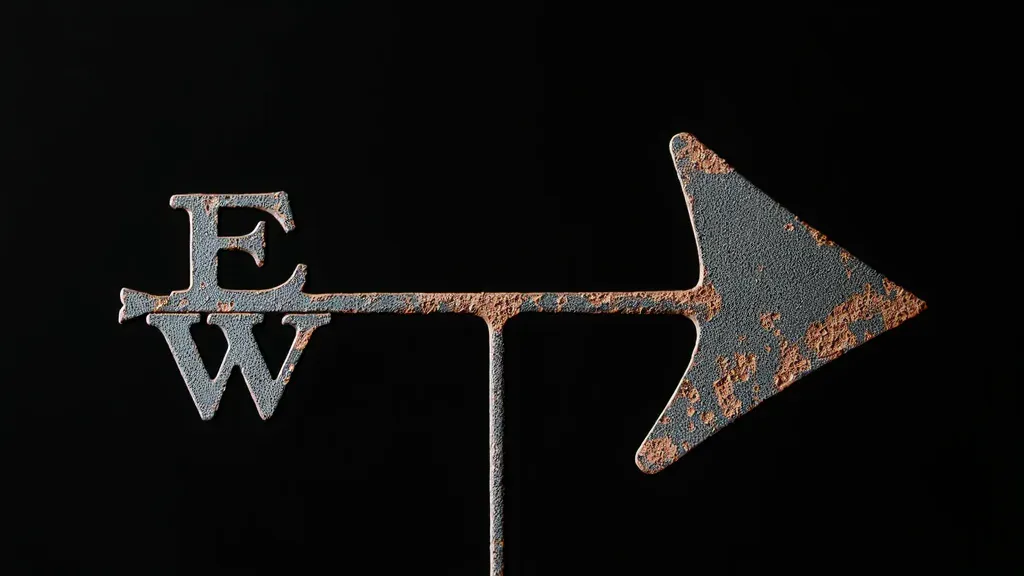
The first is the weathervane. It turns with every gust. A confident voice in the room, a clever argument over drinks, the sense that the smart people have moved on, and it swings to match. It calls this open-mindedness. It is not. A weathervane has no internal standard, so it cannot tell evidence from social weather. It ends up pointing wherever the last strong wind came from, and it feels, the whole time, like growth.
The second is the bunker. It never turns. Leon Festinger opened his study of a doomsday cult with the cleanest description of it ever written: "A man with a conviction is a hard man to change. Tell him you disagree and he turns away. Show him facts or figures and he questions your sources. Appeal to logic and he fails to see your point." He went further. Suppose the believer "is presented with evidence, unequivocal and undeniable evidence, that his belief is wrong: what will happen?" The answer: "The individual will frequently emerge, not only unshaken, but even more convinced of the truth of his beliefs than ever before." (Worth a flag, since this essay is about meeting disconfirming evidence honestly: a 2026 paper by Thomas Kelly argues the cult narrative in Festinger's book was partly manufactured by the researchers, who were embedded and helped cause what they reported. The opening diagnosis still rings true. The famous anecdote should be handled with care. Calling that out is a simple example of the discipline itself.)
Festinger named the conditions that build a bunker: deep conviction tied to action, a costly commitment that is hard to undo, a belief vague enough to reinterpret after the fact, and a group of fellow believers to drown out the doubt. Notice none of those conditions is "the evidence was strong." The bunker is not built from evidence. It is built from sunk cost and company.
A good mind is neither. It is a compass. A compass turns freely, more freely than a weathervane, but it turns toward something real. The freedom is the point and the reference is the point, and you need both. The rest of this is how to be a compass.
Decide in advance what would change your mind
Before you look at the evidence, answer one question in writing: what specific, observable thing would make me drop this belief? Not "if I'm proven wrong." Something concrete. If this metric comes back above that number. If this person does that thing. If the project misses this date.
Karl Popper made the case sixty years ago. A confirmation only counts "if they are the result of risky predictions," a prediction made before the result and genuinely able to fail. And the sharper line: "A theory which is not refutable by any conceivable event is non-scientific. Irrefutability is not a virtue of a theory (as people often think) but a vice." If nothing could change your mind, you do not have a strong belief. You have an empty one. Popper even named the timing, in a footnote about psychoanalysis: "criteria of refutation have to be laid down beforehand."
Modern science institutionalized this as pre-registration: you specify your hypothesis and what would falsify it before you see the data, because once you have seen it your brain quietly rewrites what you "always predicted." Timestamp beats memory. And borrow Eliezer Yudkowsky's emotional trick: also write down what you would do if you were wrong. He calls it leaving a line of retreat. "Planning my retreat in advance helps me think about the problem without attachment." Pre-deciding the fallback drains the fear out of the question, so you can weigh the evidence instead of flinching from it.
This is the spine the weathervane lacks. You set the bar while you were calm. Social pressure does not meet a pre-registered condition, so social pressure does not move you. Only the thing you named moves you.
Write down the objection the moment you meet it
Pre-registration handles the evidence you are waiting for. The harder problem is the evidence that ambushes you mid-stream, because your memory is not a neutral recorder. It keeps what agrees with you and lets the rest evaporate.
Darwin knew this and built a habit against it. His own words, from his autobiography: "I had, also, during many years followed a golden rule, namely, that whenever a published fact, a new observation or thought came across me, which was opposed to my general results, to make a memorandum of it without fail and at once; for I had found by experience that such facts and thoughts were far more apt to escape from the memory than favourable ones."
"Without fail and at once." That is the whole move. The rationalizing reflex acts in seconds, so you have to physically log the objection before your mind files it under "not important." Keep a running objections file for any belief or project you have a stake in. When something cuts against you, write it down in its own words, on the spot, before you rebut it. Then you owe the list answers. The payoff Darwin reported: "very few objections were raised against my views which I had not at least noticed and attempted to answer."
This is the antidote to the bunker that does not flip you into a weathervane. It does not say abandon your position the moment someone pushes. It says record the objection and answer it on the merits. The weathervane has no record and no answers, so it rotates with whoever pushed last. The bunker records only the confirming evidence, so it never has to answer anything. Darwin's rule lives in the narrow middle: collect the strongest case against yourself, owe each item a response, and let the answers, or your failure to find them, move you.
Hold beliefs as numbers, and move them in increments
Most people experience changing their mind as a binary, all-or-nothing event. Flip or hold. That framing is what produces both pathologies: the weathervane flips to relieve pressure, the bunker refuses to flip to protect its identity.
Philip Tetlock's forecasting tournaments offer a way out. The best forecasters do not flip. They nudge. "The best forecasters tend to be incremental belief updaters, often moving from probabilities of, say, 0.4 to 0.35 or from 0.6 to 0.65, distinctions too subtle to capture with vague verbiage, like 'might' or 'maybe,' but distinctions that, in the long run, define the difference between good and great forecasters."
So state the belief as a probability, not a side. Not "I think we should ship this," but "I'm at 65% this ships well." A number can be nudged. A flag in the ground can only be defended or abandoned. When evidence arrives, ask how diagnostic it really is, and move in proportion: 65 to 60, not 65 to 10. Reserve the big jumps for genuinely diagnostic signals, a confession, a hard result, and take them when they come. Incrementalism is the default, not a ban on moving fast. The superforecasters, as Tetlock puts it, also "know how to jump."
Then keep score. Track whether the things you call 70% happen about 70% of the time. The discipline guards both flanks. The number with a reason behind it is your spine against the weathervane. The scorekeeping makes belief perseverance expensive, because reality keeps grading you, which is the bunker's nightmare.
Schedule the demolition, and earn the opinion
The last two moves are Charlie Munger's, and they are mechanical on purpose.
First, schedule the demolition of a belief you love. Munger's line, from the 2004 Wesco meeting and worth quoting in its verified form rather than the smoothed version that floods the internet: "Any year that passes in which you don't destroy one of your best loved ideas is a wasted year." Make killing a cherished belief a deliverable, not an accident. Once a year, pick something you would hate to be wrong about and go hunting, on purpose, while you are calm, for the evidence that would sink it. Do it before reality does it to you at a worse time.
Second, earn the opinion before you are allowed to hold it. From his 2007 USC commencement address: "I'm not entitled to have an opinion on this subject unless I can state the arguments against my position better than the people do who are supporting it." Write your view, then write the strongest opposing case beneath it, the version its smartest advocates would actually endorse, well enough that they would say "yes, that is my argument, only better." If you cannot fill the page, or you build a strawman, you do not have an opinion. You have a preference.
This is the steelman, and it threads the needle. It fixes the bunker, because you cannot barricade around a position whose best counterargument you can recite. And it inoculates against the weathervane, because once you have done that work, you change only when a better argument actually arrives, not when the crowd shifts and the argument hasn't.
A word here on "strong opinions, weakly held," which is Paul Saffo's, often credited to others. It is a decent idea. Commit to a draft conclusion so you have something concrete to attack, then go looking for what kills it. The trouble is the failure mode, and it is worth naming plainly: in casual use the "strong" half is loud and the "weakly held" half is quiet work nobody audits, so the slogan degrades into confident assertion with built-in deniability. "I always said I'd change my mind." A bunker in weathervane clothing. The fix is not to mock the phrase. It is to make the disconfirmation step mandatory, which is exactly what Darwin, Munger, and pre-registration force.
The spine is a method, not a conclusion
Underneath all five moves is one sentence, Feynman's, from his 1974 Caltech address: "The first principle is that you must not fool yourself, and you are the easiest person to fool. So you have to be very careful about that." The clipped version drops the second half, which is the operative half. You are the easiest person to fool. Not the crowd, not your critics. You.
His instruction follows directly: "If you make a theory, for example, and advertise it, or put it out, then you must also put down all the facts that disagree with it, as well as those that agree with it." Not may. Must. He called the posture "leaning over backwards," deliberately over-weighting the case against yourself, because the default human pull is to under-weight it.
That is the third thing, the thing both failure modes lack. The weathervane has no spine because it has no internal standard. The bunker has a spine fused to one conclusion. Feynman's practice gives you a spine made of method instead of conclusions. You hold your views loosely and your standards rigidly.
Here is the cost, and I would be a weathervane to pretend it is free. The method is slow, and it stings. Pre-registering the bar, logging the objections you would rather forget, steelmanning the people you are sure are wrong, keeping a score that can convict you: every one of those moves exists to march you in front of the version of events where you are the fool, and hold you there. The discomfort is not a side effect of the method. It is the method. A way of changing your mind that felt good would not be changing your mind. It would be changing sides.
And here is what it buys, which is the cleanest test I know and the one I closed the last post on. A real update costs you something. You give up a position you were attached to, or a plan you had staked time on, or an identity you had worn. A fake update is conveniently free. It costs you nothing, it flatters whoever you are now standing next to, and it leaves no record you could be graded against later. When you change your mind, check the receipt. If it hurt, it was probably real. If it was easy, you may have just turned in the wind.
I will keep changing my mind. That is not the risk. The risk was always that I would change it for nothing. The method is how I make sure that every time I turn, I am turning toward something real.
Comments
// Comments are reviewed before appearing. No spam. No noise.