They say in Harlan County,
There are no neutrals there;
You'll either be a union man,
Or a thug for J. H. Blair.
Which side are you on?
Which side are you on?
Florence Reece, "Which Side Are You On?" (1931)
Florence Reece Writes a Song, 1931
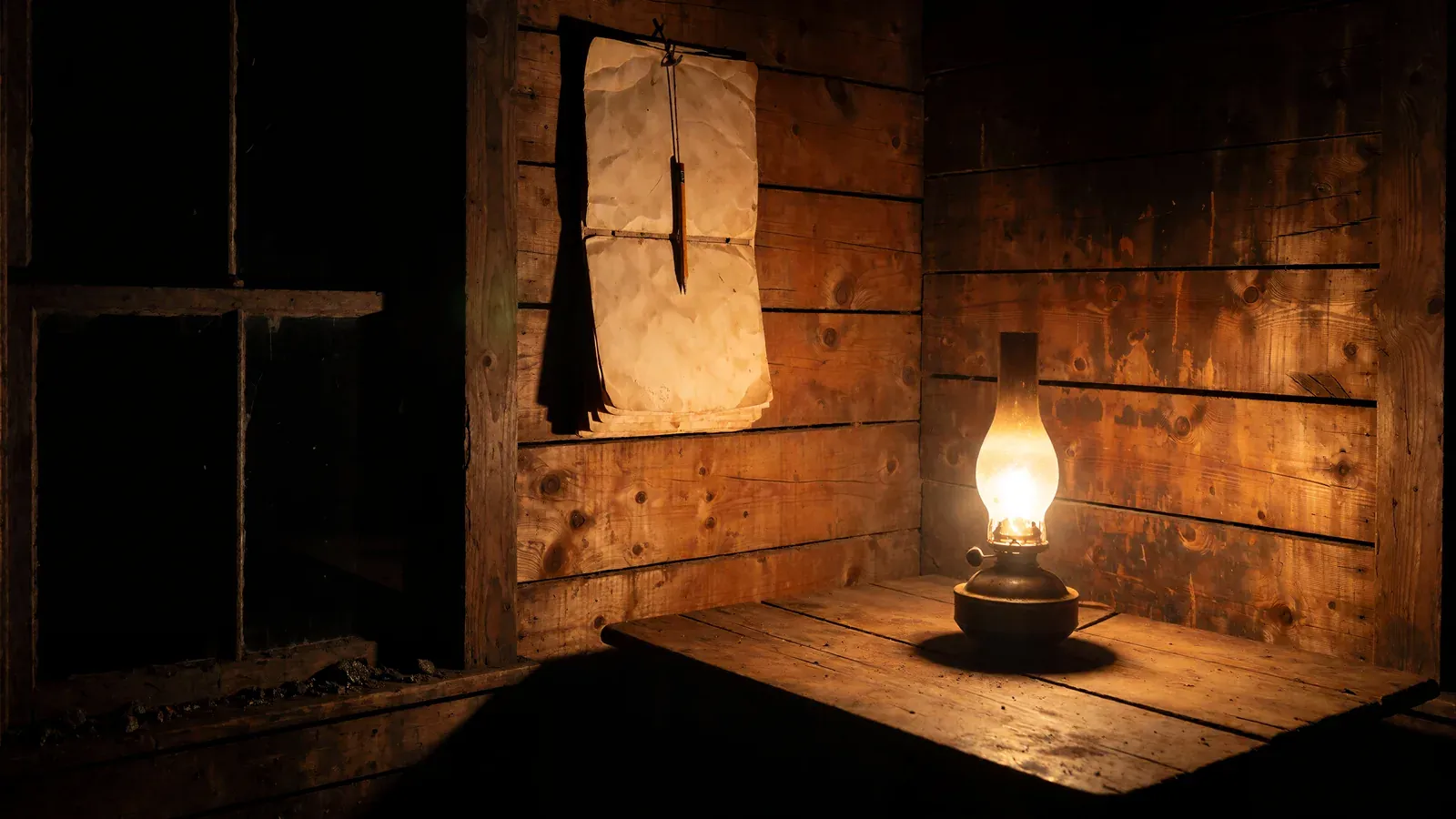
In 1931, four or five carloads of Sheriff John Henry Blair's deputies came to the Reece house on the side of Big Black Mountain in Harlan County, Kentucky, looking for Sam Reece, a union organizer. Florence Reece was home with their seven children. "They ransacked the whole house and then kept watch outside, waiting to shoot Sam down when he came back," she said later. "But he didn't come home that night." Afterward she tore a sheet from the calendar on the wall, the only paper at hand, and wrote the words to "Which Side Are You On?" "We couldn't get word out any way," she said, as later retold. "So I just had to do something."
Accounts of that day differ. The 1984 New York Times account says the deputies first jailed Sam, released him, then staked out the house with pistols and rifles, and that he stayed in the mountains. Another retelling says Florence feared the deputies meant to hold her or her son Harvey until Sam surrendered, and sent him away before she wrote. The Times calls Sam a United Mine Workers organizer; historian Cal Winslow, writing in Jacobin, ties him instead to the National Miners Union. No account fixes the date of the raid more closely than 1931.
She set the words to a tune she already knew, and named it differently over the years: an old hymn, "I'm Going to Land on That Shore," in a 1972 interview; "an old Baptist hymn, Lay the Lily Low," in her own account and in the 1984 Times; and, per folk singer Oscar Brand, who said she told him personally, the traditional ballad "Lay the Lily Low," also called "Jackaro," "Lily Munroe," or "Jackie Munroe." Folklorist Alan Lomax separately reported that she told him she had first written a version of the song in 1912, at about twelve, during a strike involving her father, and updated it in 1931; that claim rests on his account alone.
"The thugs made my mind up for me right off, which side I was on," she said, as later retold.
Coal Comes to Harlan County
Before 1911, Harlan County was a remote farming county in eastern Kentucky. A Louisville and Nashville Railroad line reached it in 1911, and the first railcar of coal left on August 25. The population went from about 10,000 in 1910 to more than 64,000 by 1930, and annual coal production from about 26,000 tons to more than 15 million by the late 1920s. World War I sent prices and wages sharply up from 1915 to 1918.
Coal companies owned the miners' houses, the stores where they bought food in company scrip no other merchant would take, and all but three of the county's incorporated towns. Law enforcement was effectively private. Sheriff Blair deputized mine guards already on the companies' payroll, giving them full county authority; one accounting of his roughly 169 special deputies found 64 with prior indictments and 27 with felony convictions, eight for manslaughter and three for murder.
The United Mine Workers organized a Harlan local in 1917, at the peak of wartime demand; it dissolved by 1924, and the UMW's national membership collapsed through the 1920s, from roughly 500,000 in 1920 to barely 100,000 by 1929.
The 1931 Wage Cut and the Strike Wave
By the late 1920s Harlan's mines were producing more coal than the market would take, and work had grown irregular. On February 16, 1931, the Harlan County Coal Operators' Association cut wages ten percent across the county. Miners' average annual pay fell from $1,235 in 1929 to $749 in 1931, and by late 1931 some working miners earned as little as 80 cents a day for a few days' work a month.
By late 1931, more than a third of Harlan's miners, over 4,000 men, had no work at all. One source counts 56 child deaths in the county in 1929, rising to 175 over 1930 and 1931. At Straight Creek, in neighboring Bell County, midwife Aunt Molly Jackson later testified that she and others buried four to seven children a week in the warm months, deaths tied to malnutrition in housing one account called "tumble-down shacks set up on stilts."
Miners organized anyway. After a March 1 union rally in Pineville, the Bell County seat, the companies retaliated: roughly 200 miners fired and blacklisted for attending, and within days 49 families evicted from Harlan Wallins housing, 60 from Black Star, and more than 175 from Black Mountain. One report describes a single vacant barn holding 28 evicted people. On March 17, UMW members called a wildcat strike at Peabody's Black Mountain mine, and evicted families crowded into Evarts, one of the few towns the companies did not own. Marches and rallies across Harlan County drew as many as 4,000 people.
The Battle of Evarts
At about 9:30 on the morning of May 5, 1931, three cars carrying nine Black Mountain mine guards, employed by Peabody Coal, passed through Evarts toward Verda. Just beyond town, where a hill rose on one side and river bottomland lay on the other, they met armed strikers. Whether the miners had set an ambush or were trying to block the cars with a picket line is still disputed. Historian John Hevener, citing 1932 Senate testimony, called it "the Evarts ambush." Jim Garland, then a miner in Harlan and Bell counties, later recalled that the guards "jumped on one of the Negro pickets and started to beat him when all hell broke loose." Accounts agree that a single shot started about thirty minutes of gunfire.
Four men died: three guards and one striker. Surviving accounts do not agree on their names. The "Bloody Harlan" label is often traced to this morning, though no source fixes when the phrase first attached to the coal camps. In the days after the shooting thousands more walked out; at the peak, 5,800 miners were idle and 900 working. On May 7, Governor Flem D. Sampson sent 300 National Guard troops to Evarts. They took weapons from miners' homes, left company guards armed, and broke up picket lines and meetings. On May 24 a union rally was tear-gassed, and Blair banned public assembly. Eight miners were later sentenced to life for conspiracy to murder; four of them were still in prison in 1938 and were not paroled until December 1941. By June 17 the last mine was back at work, and wages stayed cut. Sometime that year, Blair's deputies raided the Reece house.
How Operators, the State, and the Miners Framed the Strike
The morning after Evarts, a judge convened a grand jury and denounced "IWWs" and "Reds." That jury returned roughly 30 murder indictments and one indictment under Kentucky's 1920 Criminal Syndicalism Law, which carried up to 21 years; more than 100 were eventually charged under it. Blair put his position plainly: "I did all in my power to aid the operators ... there was no compromise when labor troubles swept the county and the 'Reds' came to Harlan County."
The judge used the "Reds" label while the strike was still officially a United Mine Workers strike; the National Miners Union moved in that summer, after the UMW withdrew. Once it did, the label had a basis: the NMU had been founded in 1928 by the Communist Party's international trade union arm, and its organizer Harry Simms belonged to the Young Communist League. Blair's deputies were later accused of planting IWW literature in a raided house, and the operator-funded Harlan Torch ran "Red Terror in the Hills" copy.
Miners described the fight as a matter of survival. Interviewed by John Dos Passos for The New Republic in December 1931, an unnamed Harlan miner said: "You starve if you work an' you starve if you don't work. A man 'ud rather starve out in the woods than starve workin' under the gun."
Reece put the miners' side in her own words: "There's no such thing as neutral. ... In Harlan County there wasn't no neutral. If you wasn't a gun thug, you was a union man. You had to be."
The National Miners Union Strike and the Relief Effort, 1931 to 1932
After Evarts, the UMW pulled back, reportedly fearing the drain on its own funds. The National Miners Union moved into the vacuum, running soup kitchens and a women's auxiliary. The Workers International Relief ran five kitchens; three were dynamited. The Evarts kitchen alone had been feeding about 400 people a day before it was bombed.
In November 1931, a committee led by novelist Theodore Dreiser traveled to Harlan and Bell counties to take testimony. The committee published its findings the next year as Harlan Miners Speak. Dreiser was indicted in absentia on criminal syndicalism charges. A separate indictment, for adultery, rested on a hotel clerk's account of toothpicks wedged into door jambs. The criminal syndicalism charges were later dropped; what became of the adultery charge is not documented in the sources reviewed for this piece. Aunt Molly Jackson went on to New York that December to raise relief money, performing before an estimated crowd of 21,000 at the Bronx Coliseum.
The National Miners Union called a general strike on January 1, 1932. It collapsed almost immediately: organizers were arrested January 4, and on February 10, Harry Simms, the twenty-year-old NMU organizer, was shot near Brush Creek in Knox County by a deputy who also worked as a mine guard; he died the next day. The strike was formally called off in March 1932, with no concessions.
The Song Leaves Harlan County
No account documents "Which Side Are You On?" being sung on Harlan's picket lines in 1931 or 1932. Reece said she sang it "for neighbors mainly, not crowds." It left the county through people. Tillman Cadle, one of Sam's fellow organizers, and folklorist Mary Elizabeth Barnicle collected it, and around 1940 Cadle, then living in New York, brought it to Pete Seeger. "I've got a new song for you, Pete," Cadle recalled telling him. "I believe it'll make a hit if you'll sing it." With the Reeces' permission, the Almanac Singers recorded it in 1941 on the album Talking Union, and that recording carried it to a national labor audience.
How Harlan Changed, and Where the Song Went
What changed the outcome in Harlan came later. Sheriff Blair was voted out of office in 1933 and died the next year. Section 7(a) of the 1933 National Industrial Recovery Act briefly protected organizing rights; when the Supreme Court struck down the NIRA in 1935, union presence in Harlan's mines collapsed from eighteen shops to one. The Wagner Act, passed later that year, outlawed the yellow-dog contracts and blacklisting operators relied on. In 1937, the Senate's La Follette Civil Liberties Committee held hearings; on April 27, miner Thomas Ferguson displayed to the committee the bloody, bullet-torn undershirt he was wearing when deputies shot him.
In 1938 a federal grand jury indicted the Harlan County Coal Operators' Association, twenty coal companies, and more than twenty peace officers, including Blair's successor as sheriff, Theodore Middleton, under a Reconstruction-era civil rights statute; the trial ended in hung juries, and no operator or deputy was convicted. Kentucky also banned private mine guards that year. In 1939, Harlan operators still refused the national UMW contract, and a violent confrontation with the Kentucky National Guard killed two more miners before operators finally accepted a union contract. Federal law, a Senate investigation, a failed prosecution, a state law, and renewed violence changed Harlan's outcome. No source ties the song to any link in that chain.
The song's influence came later, mostly outside Harlan. In 1961, CORE leader James Farmer, jailed in Mississippi during the Freedom Rides, is credited with rewriting its verses against the state's segregationist governor, Ross Barnett. In 1962, SNCC organized the Freedom Singers, whose tours covered roughly 50,000 miles and reportedly raised nearly $50,000 for SNCC. In 1973 and 1974, Florence Reece, then 73, sang it at the UMWA's national convention and on the picket lines of the Brookside strike, which won a new contract after young miner Lawrence Jones was shot and killed; no account credits the song with the settlement. In 1976, Barbara Kopple's documentary Harlan County, USA used Reece's live performance as a recurring device. Historian Grace Elizabeth Hale said the song works "like an exclamation mark" in the film, Reece's voice becoming "the voice of the documentary, repeatedly asking the film's central question." The film won the 1977 Academy Award for best documentary feature. Billy Bragg adapted it for the 1984 to 1985 UK miners' strike; his version appeared on the 1985 EP Between the Wars, which reached number 15 on the UK chart.
Florence Reece's Later Years
Reece kept singing it. In Harlan County, USA, she tells the strikers: "I'm old and I can't sing very well, but you can ask the scabs and the gun thugs what side they're on because they are workers too." According to Guy Carawan, the first album recording of her singing it was one he and Candie Carawan made in 1980 at her home in Fountain City, Tennessee. She died in Knoxville on August 3, 1986, at 86.
Sources
- Hevener, John W. "Which Side Are You On? The Harlan County Coal Miners, 1931-39." University of Illinois Press, 1978. https://www.press.uillinois.edu/books/catalog/52grh4ny9780252070778.html
- Dreiser, Theodore, John Dos Passos, Sherwood Anderson, et al. "Harlan Miners Speak: Report on Terrorism in the Kentucky Coal Fields." National Committee for the Defense of Political Prisoners, 1932. https://www.kentuckypress.com/9780813191874/harlan-miners-speak/
- Serrin, William. "Labor Song's Writer, Frail at 83, Shows She Is Still a Fighter." The New York Times, March 18, 1984. https://www.nytimes.com/1984/03/18/us/labor-song-s-writer-frail-at-83-shows-she-is-still-a-fighter.html
- "Harlan County War." Wikipedia, accessed 2026. https://en.wikipedia.org/wiki/Harlan_County_War
- Bishop, Bill. "1931: The Battle of Evarts." Southern Exposure, republished by Facing South. June 1, 1976. https://www.facingsouth.org/1931-battle-evarts
- Soodalter, Ron. "The Price of Coal, Part I." Kentucky Monthly, September 30, 2016. http://www.kentuckymonthly.com/culture/history/the-price-of-coal/
- "Harry Simms (labor leader)." Wikipedia, accessed 2026. https://en.wikipedia.org/wiki/Harry_Simms_(labor_leader)
- Hale, Grace Elizabeth. "Documentary Noise: The Soundscape of Barbara Kopple's Harlan County, U.S.A." Southern Cultures, vol. 23, no. 1, 2017. https://www.southerncultures.org/article/documentary-noise-soundscape-barbara-kopples-harlan-county-u-s/
- "'Which Side Are You On?': How Florence Reece Gave Strikers a Theme Song." Mental Floss, 2023. https://www.mentalfloss.com/entertainment/music/which-side-are-you-on-florence-reece-protest-song
- "Hall of Fame: Power of Arts and Creative Expression." Labor Heritage Foundation, 2009 (archived). https://web.archive.org/web/20120310073845/http://www.laborheritage.org/?p=249
- Winslow, Cal. "No Neutrals in Harlan County." Jacobin, August 14, 2019. https://jacobin.com/2019/08/harlan-county-miners-history-strike-kentucky
Comments
// Comments are reviewed before appearing. No spam. No noise.