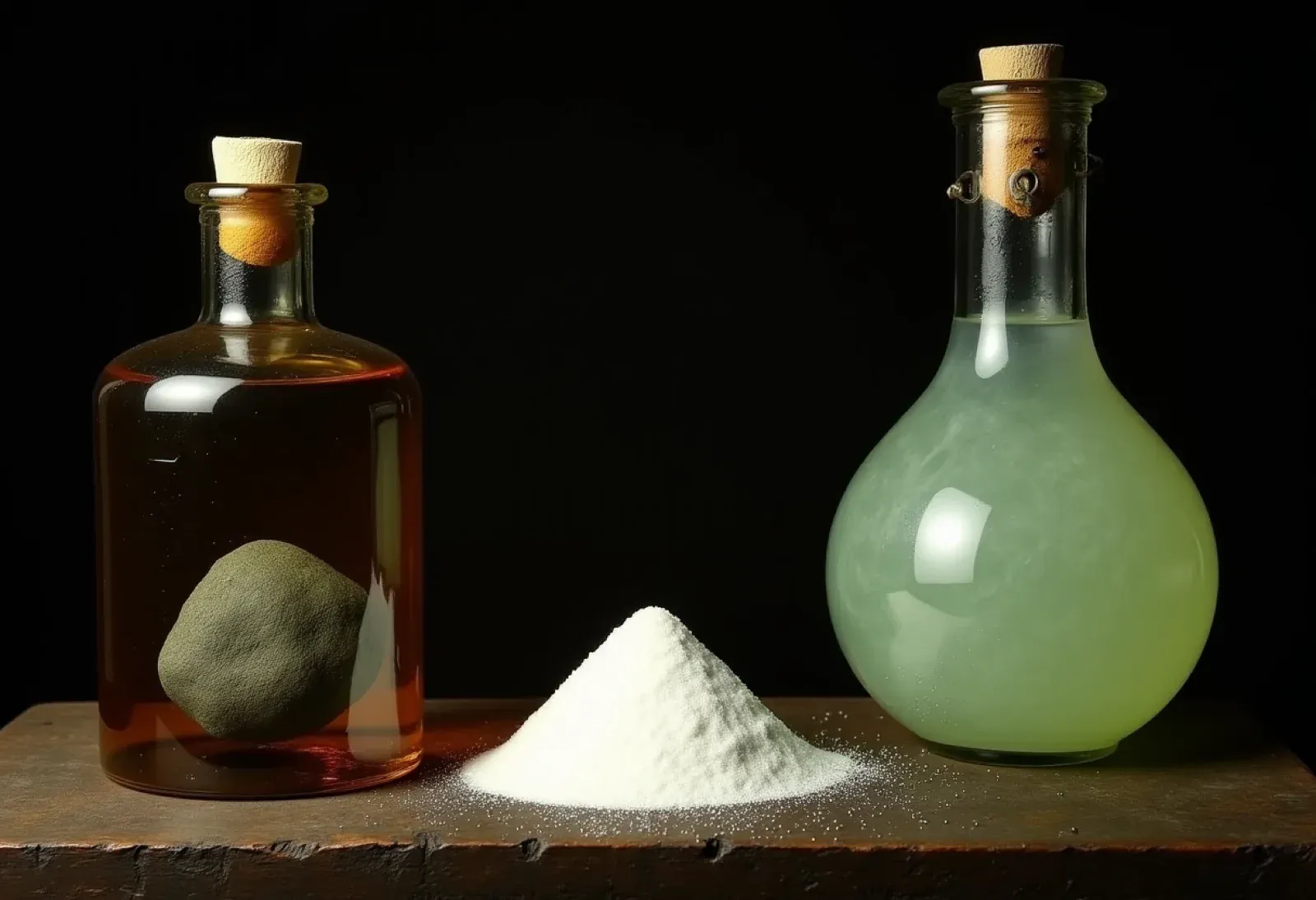
For years one of my favorite idioms has been that "The whole can be greater than the sum of its parts". Sodium is a grey metal soft enough to cut with a butter knife. It is stored under oil, because if it touches water it ignites, and a large enough piece will take the sink with it.
Chlorine is a green gas. On the afternoon of 22 April 1915 the German army opened thousands of cylinders of it into a favorable wind at Ypres, and it rolled low across the ground into the French and Algerian trenches, and men drowned standing up in open air.
Bond one to the other and you get the white crystal in the shaker on your kitchen table. You will die without it. Sodium carries the electrical signal down every nerve you have. Chloride makes the acid in your stomach. A human body holds something like 250 grams of the stuff and spends real metabolic effort hanging on to it.
Nothing in salt hints at what it used to be. Not one property of either half survived the bond. The metal does not burn, the gas does not choke, and what is left is something neither one could have been alone.
I want to talk about people. I am going to take the long way around, because the chemistry says it better than I can.
Atoms bond because of what they lack
Here is the part I find genuinely beautiful, and it is freshman chemistry, nothing exotic.
Sodium has a single electron rattling around its outer shell, one more than a stable configuration wants. Chlorine has seven, one short of a full set. Sodium is unstable because it is carrying something it cannot use. Chlorine is unstable because it is missing something it needs. Put them together and sodium hands the electron over. Both shells close. The result is so stable it sits dissolved in the ocean for geological time without coming apart.
The bond exists because of the deficiency. Not in spite of it. Had sodium been complete, nothing happens at all. The two of them are useful to each other in exactly the place each one is broken.
That is the whole essay. The rest is application.
Now hold it up next to how most of us actually behave. We treat our gaps as things to hide, or to grind out privately at night until nobody can see them anymore. Some of that work is worth doing. But a gap is also the only place another person can attach. Sanded smooth and sealed over, you are not stronger. You are inert.
Which brings up the other end of the periodic table.
The most self-sufficient elements are the least useful ones
Argon, neon, helium and the rest of the noble gases have full outer shells. Complete. Nothing to give, nothing to take. And they react with almost nothing. Helium has been in the atmosphere for the entire history of life on this planet and has never joined anything. (Chemists have forced a few noble gas compounds into existence using fluorine, cryogenic temperatures and a great deal of persuasion, which mostly tells you the price of the exception.)
The noble gases are the most independent elements on the table, and nothing is built out of them. Your body contains none of them. No mineral, no protein, no cell membrane. They drift around at room temperature declining to participate.
I have run long stretches of my life in a noble gas configuration and I understand the appeal. If you need nothing, nothing can let you down. You never have to explain a weakness, coordinate a schedule, or trust somebody else's judgment over your own. The cost never shows up as a failure. It shows up as an absence, which is much harder to notice: all the compounds you were never part of.
Nothing in the bowl tastes like bread
The kitchen version of this is easier to feel.
Flour is dust. It tastes like paste. Raw egg is slime. Yeast is a fungus. Salt is a rock. Water is water. Not one of those is worth eating, and there is no clever arrangement of them on a plate that would be.
Put them together, work them, and add heat, and you get bread, which is one of the better things there is. The crust alone comes from the Maillard reaction, amino acids and sugars rearranging under heat into hundreds of new aroma compounds that were present in none of the ingredients. You cannot find the smell of a bakery anywhere in the raw materials. It gets manufactured on the spot, by the interaction, out of nothing that was there before.
Farming has the same lesson written into a field. Corn, beans and squash planted together, the way the Haudenosaunee and many other peoples have grown them for centuries: the corn gives the beans a stalk to climb, the beans host bacteria that pull nitrogen out of the air and feed the corn, the squash sprawls broad leaves across the ground to shade out weeds and hold moisture in the soil. Agronomists measure this with a land equivalent ratio, comparing an intercrop against the same plants grown in separate plots. Well matched intercrops routinely come in above one, meaning a single acre farmed together yields what more than an acre farmed apart would. The plants are not working harder. They are covering for each other.
Adam Smith opened The Wealth of Nations with the industrial version. A man alone, untrained in the trade, "could scarce, perhaps, with his utmost industry, make one pin in a day, and certainly could not make twenty." Ten men who split the job into eighteen distinct operations, one drawing the wire, one straightening it, one grinding the point, made upwards of forty-eight thousand pins in a day. Not double. Not ten times. Something closer to two hundred times each.
You do not have to be the best at anything
There is a worry that stops people from asking, and it goes like this: what do I actually bring? She is better than me at this. I would be taking more than I give.
David Ricardo settled that in 1817 and almost nobody has internalized it. His point, stripped of the economics: even if your partner is better than you at every single task on the list, both of you still come out ahead by dividing the work along relative strength. Say she is twice as good as you at the design and ten times as good at the wiring. She should do the wiring, you should do the design, and together you finish more than either of you would working down the whole list alone. Her being better than you at your job does not make your contribution charity she is extending to you. It makes it arithmetic.
You never have to be the best at anything to be worth having. You have to be differently shaped, and you have to be there.
Most mixtures are just mixtures
I am not going to pretend any of this happens by default, because it does not.
Stir sand into sugar and you have sand in sugar. No reaction, no new properties, nothing you could not have predicted from the two jars. What you have is a worse version of both and a tedious job separating them later. A great deal of what gets called collaboration is exactly this. Committees. Standing meetings with nine attendees and one decision. Group projects. All the parts in one container, nothing bonded.
In the 1880s a French agricultural engineer named Maximilien Ringelmann had men pull on a rope, alone and in groups, and measured the force on the line. One man averaged about 63 kilograms. Eight men together should have moved roughly 500. They managed about half of that. Every person added made every person already there, himself included, pull less hard. Ringelmann was measuring oxen and horses and men and draft equipment, and he found the same sag everywhere he looked.
So the honest baseline is not one plus one is greater than two. The honest baseline is that one plus one tends to land near 1.6, and getting above 2 is a specific achievement with conditions attached. A reaction is much rarer than a mixture, and the difference between them is not how badly anyone wanted it.
What a reaction needs
Chemistry is specific about this, and so is cooking. Four conditions, each with a human move attached.
Complementary valence. You need what the other person is carrying too much of, and they need what you are short on. Overlap feels wonderful and produces nothing. The comfortable collaborator is usually the duplicate, the one who agrees with you because he thinks the way you think and has his blind spots in all the same places. Sodium and chlorine have nothing whatsoever in common. That is the reason it works.
The move here is uncomfortable and it is the one that matters: say your gap out loud, early, to somebody who does not share it. Nobody can bond to a shell you are pretending is full. Every time I have hidden a weakness in order to look competent, I have made myself unreachable in precisely the place I needed reaching.
Activation energy. Reactions do not start on their own. Sodium and chlorine will sit in the same room indefinitely doing nothing until something puts in the first push. Then the reaction gives off far more energy than the push cost.
The human version is that somebody has to go first, and going first is always a little humiliating. The message you are not sure is welcome. The offer of help that might be declined. The admission that you are stuck. That first push is small and it feels enormous, and the reason most possible partnerships never happen is not incompatibility. It is that both people stood there waiting for the other one to spend the activation energy.
Contact, and shared air. Reagents have to actually touch, and they have to keep touching. The best evidence I know here is a 2010 study in Science by Anita Woolley and colleagues, hunting for a collective intelligence factor across groups doing varied tasks. What predicted a group's performance was not the average intelligence of its members, and it was not the intelligence of the smartest member. It tracked two much humbler things: how well members read each other socially, and how evenly the talking was distributed. Groups where a few people dominated the conversation did worse than groups that shared the floor. (The effect is real but modest, and the follow-up literature has argued about its size. The turn-taking finding has held up best.)
Read that twice if you are usually the smartest person in your room. Dominating the discussion makes you a barrier, not a reagent.
Heat, applied to the right thing. Maillard needs heat. There is no route to a crust that goes around the oven. Too much heat and you have carbon, and it happens fast.
Wilbur and Orville Wright argued so hard that their mechanic Charlie Taylor said they would shout at each other something terrible, and there is a well worn story that after hours of it each would find himself arguing the other's original position. Wilbur put it plainly: "I love to scrap with Orv. Orv is such a good scrapper." They fought constantly about the problem and never about each other, and they got a machine into the air ahead of far better funded men who had nobody to scrap with.
Friction on the idea builds flavor. Friction on the person burns the dish. The difference is not subtle, and everybody in the room can tell which one is happening.
Catalysts and emulsifiers
Not everyone is half of a given pair, and there is a role available that matters more than either reagent.
A catalyst makes a reaction happen and comes out the other side unchanged. It is not consumed and it does not appear in the product. All it does is lower the activation energy, so a reaction that was technically possible becomes actually likely. Most industrial chemistry is impossible without one.
An emulsifier does the same job in a kitchen. Oil and water will not stay mixed no matter how hard you whisk them. Add an egg yolk, whose lecithin has one end that likes water and one end that likes fat, and you get hollandaise instead of a broken puddle. The yolk is not the flavor. It is the reason the flavors can hold together.
Those are the people who introduce two friends who should obviously already know each other. Who host the thing. Who tell you which neighbor has the tractor and mention to that neighbor that you know how to weld. Who keep the potluck, the group chat, the standing Thursday.
This is what I actually mean by community, and it is not a pile of people. It is a medium in which reactions are likely. You build it by spending activation energy on other people's behalf, repeatedly, for combinations you are not part of and get no credit for. It takes no particular talent, it is available to anyone, and it compounds, because the reactions you catalyze go on to produce people who catalyze.
If you cannot find your own complement yet, start here. Be the yolk.
The salt on the table
My son rebuilt the dashboard that runs our house. I had the servers, the sensors down in the cistern, the years of knowing where every wire goes. He had none of that. He had taste, and stamina, and a complete unwillingness to accept that a thing had to look the way I had made it look.
What he built is better than what I would have built, and better than what he would have built, and I can no longer cleanly separate my part of it from his. That is what a bond looks like from the inside. The pieces stop being retrievable.
I did not go looking for that collaboration. It happened because he asked for something and I said yes, which is a very small amount of activation energy for the compound it produced.
His first few versions were bad. Not promising-rough, actually bad, the kind of bad where the honest thing to say and the kind thing to say seem to point in opposite directions. That gap is where most collaborations quietly die, and it is worth being clear about why. Pointing at what is wrong costs nothing, and the world hands it out for free: there is a bottomless supply of people who will tell you your work is bad, and most of it is a search box away. What is scarce is someone who will name the specific thing they are good at, put it in your hands, and stay while you learn to hold it. Exposing a weakness is a commodity. Covering it is where the relationship actually lives.
So I tried to do the second thing. I did not pretend a broken version worked, because that is its own quiet insult. I said what was not working, and then I put the part I knew next to the part he was building, the wiring and the years of it, and let the next version be ours instead of his under grade. The heat stayed on the work and never once touched him. A few iterations later he was better than I had ever been at the thing I was supposed to be teaching.
So, the practical version, and then I will stop.
Go find the person who is strong where you are weak, and tell them plainly where you are weak, because that is the only bonding site you have and covering it over turns you into argon. Spend the activation energy first rather than waiting to be approached. Argue hard about the work and never about the person. And when you are not half of a pair, be the catalyst for somebody else's.
The parts of yourself you would trade away, the incompleteness you have been quietly embarrassed by, are the reason anything can attach to you at all. Sodium is dangerous because it has one electron too many. That is also the only reason it can become salt.
Comments
// Comments are reviewed before appearing. No spam. No noise.