
Every few years someone rediscovers the idea that sleep can be cut into pieces. A seventeenth-century household woke around midnight and went back to bed. Buckminster Fuller napped for half an hour four times a day. A blogger in 2005 set a timer six times around the clock. The accounts survive in diaries, a 1943 magazine column, a sleep journal and archived blog posts, and the people who wrote them were honest about what it felt like.
I have insomnia. My only interest in polyphasic sleep is whether any of this history makes the condition easier to live with. So I read it the way an insomniac reads anything about sleep, looking for a lever.
First Sleep, Second Sleep
The historian A. Roger Ekirch spent years collecting references to a night that came in two parts. His 2001 article in the American Historical Review and the 2005 book At Day's Close describe a pattern he found in diaries, court records, medical books and literature: people went to bed a few hours after dusk, woke around midnight for an hour or so, then slept again until dawn. The BBC reported in 2012 that his book unearths more than 500 references to this segmented pattern, and that references to the first and second sleep started to disappear during the late 17th century. Ekirch ties the fade to street lighting, domestic lighting and coffee houses.
What persuaded him was the tone of the sources more than the count. "It's not just the number of references," he told the BBC, "it is the way they refer to it, as if it was common knowledge." By his account the waking hour had its own uses: prayer (late fifteenth-century prayer manuals carried prayers for the interval), reading, sex, tending the fire, visiting neighbors.
His reading has been challenged. In 2023 Niall Boyce, writing in Medical History, argued the same evidence can support non-segmented models of early modern sleep. Ekirch answered in 2024: "A voluminous quantity of evidence that has since emerged has only strengthened my conviction that the predominant pattern of Western sleep in the pre-industrial world was segmented, whereby most individuals usually retired between 9 and 10 p.m., awakened from their 'first sleep' about midnight or later, remained awake on average for up to an hour or so, and then took a 'second sleep' roughly until dawn." Boyce's rejoinder called the question "by no means settled."
The field data narrows the claim further. Yetish and colleagues put wrist monitors on 94 people in three societies without electricity (the Hadza, the San and the Tsimane) and reported about 6.4 hours of sleep a day, little napping, and no segmented pattern. Samson's group found the Hadza napped often, and found something closer to Ekirch's night among farmers in a nonelectric village in Madagascar: a waking period after midnight plus a nap at noon.
So the defensible version is smaller than the popular one. Pre-electric sleep was flexible. Some people slept twice, some slept once and napped. The record does not support one natural schedule that everyone followed before the light bulb.
Fourteen Hours of Dark
Thomas Wehr at the National Institute of Mental Health ran the laboratory version. His 1992 paper in the Journal of Sleep Research opens plainly: "Results of a photoperiod experiment show that human sleep can be unconsolidated and polyphasic, like the sleep of other animals." Volunteers were moved from a conventional 16-hour light period to a 10-hour one, fourteen hours of dark. Their sleep, in the abstract's words, "expanded and usually divided into two symmetrical bouts, several hours in duration," with a waking interval of one to three hours between.
Two details get lost in retellings. The subjects slept more, not less: this is a long night splitting in two, the reverse of the two-hour schedules further down. And it was a lab with enforced darkness, which shows what the body does under those conditions, not what it prefers. Wehr told Scientific American that waking after a couple of hours "may not be insomnia" and "may be normal sleep," and that line has travelled a long way on its own.
The Genius Nappers
Then there is the familiar list: da Vinci on fifteen-minute naps every four hours, Tesla on two hours a night, Edison on four, Napoleon on four. Almost none of it traces to a primary source. The da Vinci schedule, the one later christened Uberman, has no traceable primary source; the story appears to come from twentieth-century popular science writing. Tesla's two hours is usually traced to a 1944 biography and anecdotes about 3 a.m. phone calls, and Tesla himself was known to embellish. Napoleon's rests on an alleged line of uncertain authenticity.
What is documented is napping. Edison's napping is well attested, and a story circulates of him dozing with steel balls in his hands so that dropping them would wake him. Churchill is the best-documented case. His grandson Nicholas Soames has said he went to bed in pajamas after lunch for about two and a half hours, then worked into the early hours. That is a long day with a split in it, closer to the Madagascar farmers than to anything that follows.
Dymaxion Sleep
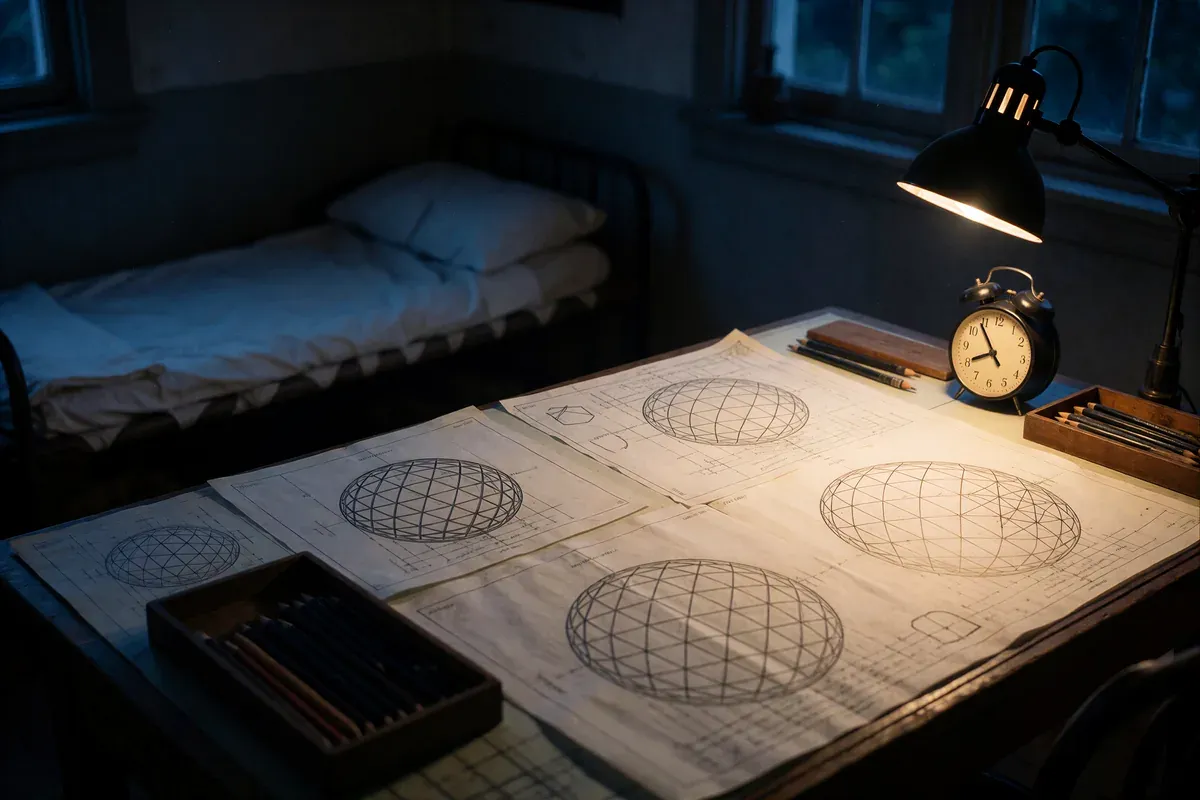
Buckminster Fuller is the earliest person in this story to try a nap-only schedule on purpose and report the result. Time magazine covered it in 1943 under the heading "Science: Dymaxion Sleep," Dymaxion being the brand word he also put on his house, car and map. "Two hours of sleep a day, he said firmly, is plenty." Time described the practice: "Fuller trained himself to take a nap at the first sign of fatigue (i.e., when his attention to his work began to wander). These intervals came about every six hours; after a half-hour's nap he was completely refreshed. For two years Fuller thus averaged two hours of sleep in 24." He called the result "The most vigorous and alert condition I have ever enjoyed," and Time added that life-insurance doctors found him "sound as a nut."
The same column gives the reason he stopped. "Eventually he had to quit because his schedule conflicted with that of his business associates, who insisted on sleeping like other men." This is one self-report from a famously self-mythologizing man, printed a decade after an experiment that by later accounts ran around 1932 and 1933. No sleep lab ever recorded it.
Stampi and the Sailors
Claudio Stampi edited the 1992 volume Why We Nap, and his 1989 field study in Work & Stress followed 99 sailors.
Solo ocean racers are a population for whom chopped sleep is a condition of the job. Sail Magazine lists Mike Golding and Ellen MacArthur among Stampi's clients, and reports his research as putting the floor at four and a half to five and a half hours per 24 to avoid piling up sleep debt, more than double the two hours Uberman and Dymaxion promise. A PBS science program in the early 1990s also reported a case from Stampi's lab in which a young man napped about three hours a day for 49 days with all sleep stages represented. That single reported case is the only lab evidence for the extreme schedules that I found.
Naming Uberman
The internet era begins with a pseudonym. Puredoxyk started experimenting around 2000, named the Uberman schedule, and kept a blog, Transcendental Logic, that now survives only in the Internet Archive. She wrote about the schedule with no illusions about its cost: "I called it 'Uberman' for a reason, yo. It's not easy to get used to. It takes a month to really get into the swing of it, as others have proven; and that's an uncomfortable month. If the benefits to you aren't worth that discomfort, just don't do it!"
In July 2006, on a second Uberman attempt that collapsed for lifestyle reasons (she could not drive once sleep deprived), she coined the softer schedule: "Hey, I thought of a name for modified / core-sleeping schedules! We can call them 'Everyman' Sleep Schedules." The same post carries the lesson: "Uberman is not something you can in any way 'fit your existing life into'; it's something you have to tear your life down and rebuild around."
The best-documented attempt belongs to Steve Pavlina, who started on 20 October 2005 and blogged it daily. His first post defined the target: the "Uberman sleep schedule, suggests that you sleep 20-30 minutes six times per day, with equally spaced naps every 4 hours around the clock. This means you're only sleeping 2-3 hours per day." His naps fell at 1, 5 and 9, morning and evening, each on a 30-minute timer.
His wife Erin wrote a guest post that October. "I feel so strange going to sleep at night knowing that he will be up for nearly all of the night."
He stopped after about five and a half months, in April 2006. "The #1 reason I decided to call it quits is simply that the rest of the world is monophasic. If most of the world was polyphasic, I probably would have stuck with it. Obviously when you go polyphasic, you fall out of sync with the way other people live. You're awake most of the night while everyone is asleep." He said the strangeness was not the reason, since he had adapted to it.
Fuller, Puredoxyk and Pavlina all gave the same reason for stopping or softening, and it was social fit. In the sources I read, none of the three wrote that the schedule stopped working.

The Schedules
- Monophasic, about 7 to 9 h a day: one block (the industrial norm).
- Biphasic (siesta), about 6.5 to 8 h a day: about 6 to 7 h at night plus one afternoon nap of 20 to 90 min (siesta cultures; Churchill's afternoons).
- Segmented, about 7 to 8 h a day: two night blocks with 1 to 3 h awake between (Ekirch for the history, Wehr for the lab).
- Everyman, about 4 h a day: a 3 h core plus three 20 min naps (Puredoxyk, 2006).
- Uberman, about 2 to 3 h a day: six naps of 20 to 30 min, one every 4 h (Puredoxyk; Pavlina's 2005 trial).
- Dymaxion, about 2 h a day: four 30 min naps, one every 6 h (Fuller, per Time in 1943).
Sources disagree on whether an Uberman nap is 20 or 30 minutes, so I give both.
What the Science Found
The Sleep Foundation calls research on these schedules "very limited," and I could not find a controlled long-term trial of Uberman or Everyman. The most comprehensive review I found is a 2021 National Sleep Foundation consensus panel (Weaver and colleagues, Sleep Health). They stated the claim under test, "Polyphasic-sleep advocates claim to thrive on as little as 2 hours of total sleep per day," excluded nap and siesta schedules, and from 40,672 potentially relevant publications retained 22 papers. Their conclusion: "We found no evidence supporting benefits from following polyphasic sleep schedules. Based on the current evidence, the consensus opinion is that polyphasic sleep schedules, and the sleep deficiency inherent in those schedules, are associated with a variety of adverse physical health, mental health, and performance outcomes."
The study that best explains the glowing self-reports is a restriction study rather than a polyphasic one. Van Dongen and colleagues (Sleep, 2003) kept 48 adults on 4, 6 or 8 hours in bed for 14 nights with all other sleep prohibited, so the short arms were consolidated blocks, not naps. They found that "chronic restriction of sleep to 6 h or less per night produced cognitive performance deficits equivalent to up to 2 nights of total sleep deprivation." The line that bears on Fuller's "most vigorous and alert condition": "Sleepiness ratings suggest that subjects were largely unaware of these increasing cognitive deficits, which may explain why the impact of chronic sleep restriction on waking cognitive functions is often assumed to be benign." Sleepiness ratings did not significantly differ between the four-hour and six-hour groups. Uberman advocates claim to thrive on two. Even the rare natural short sleepers, carriers of DEC2 or ADRB1 mutations found in family studies, sleep about six hours or less, and they take it in one consolidated block at night.
What an Insomniac Can Take From This
Here is what the history legitimately offers me. If Ekirch is right, waking at 3 a.m. has a long and ordinary past: people did it as a matter of course, prayed or talked through it, and went back to sleep. Farmers in a nonelectric Madagascar village did something similar in Samson's study. Russell Foster told the BBC that "Many people wake up at night and panic," and the panic is the part this history can reach. Lying awake feels less like a malfunction once you know late fifteenth-century prayer manuals carried prayers for it.
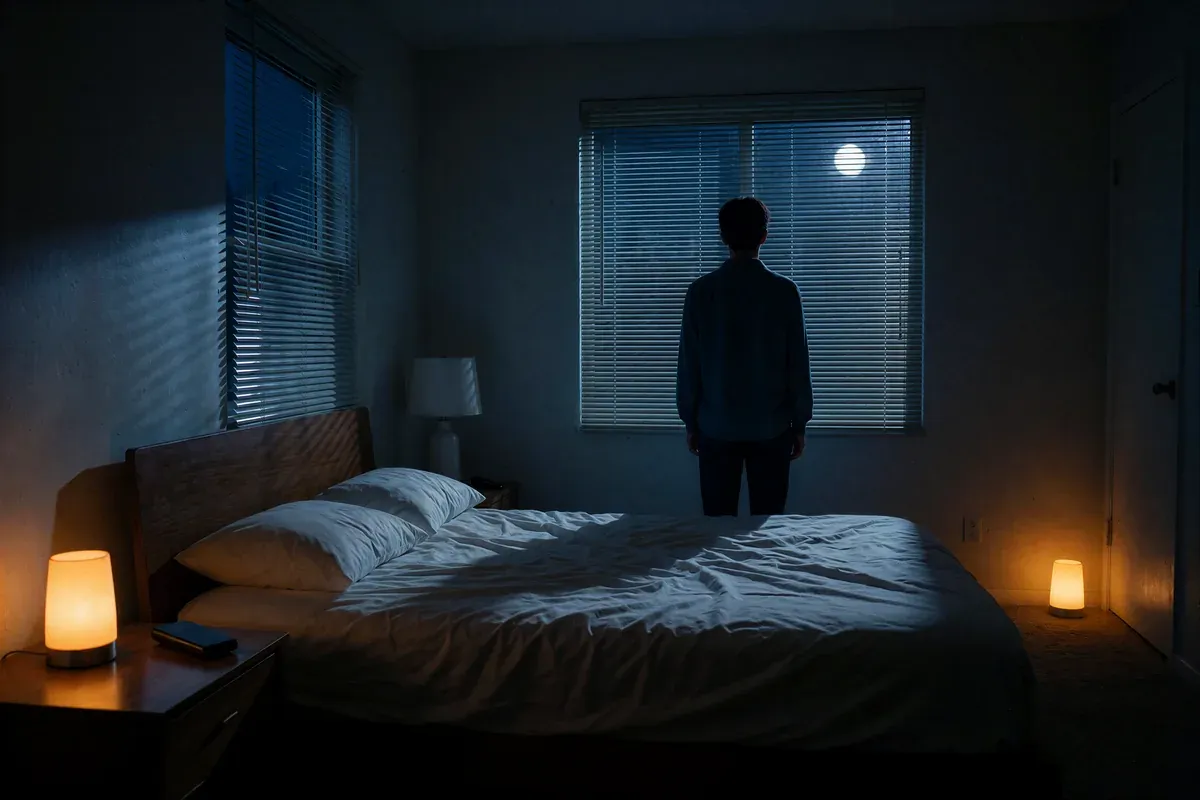
Here is what it does not offer. I found no trial, guideline or review that recommends segmented or polyphasic sleep as a treatment for insomnia. Ekirch's claim is about what was predominant, not what was healthy. Wehr's subjects were sleeping more, not less. And the people who built the short schedules could fall asleep on a timer six times a day, the exact talent insomnia removes.
The clinical approach runs the other way. The American Academy of Sleep Medicine's 2021 guideline makes one strong recommendation for chronic insomnia: multicomponent cognitive behavioral therapy for insomnia. Two of its components are the inverse of the polyphasic move. Stimulus control, as the guideline lays it out: "(a) go to bed only when sleepy; (b) get out of bed when unable to sleep; (c) use the bed/bedroom for sleep and sex only (no reading, watching TV, etc. in bed); (d) wake up the same time every morning; (e) refrain from daytime napping." That last instruction rules out the premise of every nap-based polyphasic schedule.
Sleep restriction shares a word with polyphasic schedules while meaning the reverse. The guideline defines it as "A method designed to enhance sleep drive and consolidate sleep by limiting time in bed equal to the patient's sleep duration," with time in bed then adjusted until sleep is sufficient. Uberman advocates claim that cutting sleep and scattering it into short naps trains the body to reach deep sleep quickly. Restriction cuts time in bed so that the sleep you do get arrives in one piece, then adjusts the hours as sleep improves.
There is a gentler variant. Sleep compression, as Lichstein and colleagues describe it, "does use an incremental approach to decreasing time in bed, as compared to abrupt contraction in the method of sleep restriction," with a worked example trimming "about 20 minutes a week" toward the hours actually slept. Their statement of the goal is the one I keep returning to: "Decreasing wake time in bed, not increasing sleep, becomes the primary therapeutic goal." A 2025 trial of 234 people (Jernelöv and colleagues, Sleep) found compression improved things less and more slowly than restriction, and concluded it "can be a valid alternative when sleep restriction therapy cannot be used."
So the history and the clinic hand me two different things. From the history: a 3 a.m. waking is not evidence that I am broken, and in Ekirch's sources the hour was often put to use, with prayer, reading and conversation. From the clinic: make the night smaller first, keep it in one piece, and give up the daytime nap that the nap-based polyphasic schedules depend on. Fuller, Puredoxyk and Pavlina each learned that a sleep schedule has to fit a life. Mine has to fit a body that will not sleep on command, and for that the people who chopped their nights into pieces have nothing to offer except company at 3 a.m., which is worth something.
Sources
- A. Roger Ekirch, "Sleep We Have Lost: Pre-industrial Slumber in the British Isles," American Historical Review, 2001. https://www.cambridge.org/core/product/B70D0BFF8E77CFB81A839E9B72240CF2/core-reader
- A. Roger Ekirch, "Reflections on 'Have we lost sleep?'," Medical History, 2024. https://www.cambridge.org/core/services/aop-cambridge-core/content/view/85ACD24ADCEEA5725E3CADC63DB58922/S0025727324000206a.pdf/reflections-on-have-we-lost-sleep.pdf
- Stephanie Hegarty, "The myth of the eight-hour sleep," BBC News Magazine, 2012. https://www.bbc.com/news/magazine-16964783
- Niall Boyce, "Have we lost sleep? A reconsideration of segmented sleep in early modern England," Medical History, 2023. https://www.ncbi.nlm.nih.gov/pmc/articles/PMC10404514/
- Niall Boyce, "Response to: Reflections on 'Have we lost sleep?'," Medical History, 2024. https://pmc.ncbi.nlm.nih.gov/articles/PMC11655158
- Yetish et al., "Natural sleep and its seasonal variations in three pre-industrial societies," Current Biology, 2015. https://teams.semel.ucla.edu/sites/default/files/publications/15_hunter-gatherer_yetish_siegel_et_al_final_version_0.pdf
- Samson et al., Hadza sleep biology, American Journal of Physical Anthropology, 2017. https://digitalscholarship.unlv.edu/anthro_fac_articles/382
- Samson et al., segmented sleep in a nonelectric agricultural society in Madagascar, American Journal of Human Biology, 2017. https://scholars.duke.edu/publication/1175924
- Thomas A. Wehr, "In short photoperiods, human sleep is biphasic," Journal of Sleep Research, 1992. https://pubmed.ncbi.nlm.nih.gov/10607034/
- Time, "Science: Dymaxion Sleep," 1943. https://content.time.com/time/subscriber/article/0,33009,774680,00.html
- Claudio Stampi, "Polyphasic sleep strategies improve prolonged sustained performance: a field study on 99 sailors," Work & Stress, 1989.
- Claudio Stampi (ed.), Why We Nap: Evolution, Chronobiology, and Functions of Polyphasic and Ultrashort Sleep, Birkhauser, 1992.
- Sail Magazine, "Sleep and Seamanship." https://sailmagazine.com/cruising/sleep-and-seamanship/
- Puredoxyk, "Thoughts on 'Core Sleep'," Transcendental Logic, 2006 (Internet Archive). http://web.archive.org/web/20100904004726/http://www.puredoxyk.com/index.php/2006/05/27/thoughts-on-core-sleep/
- Puredoxyk, "Day 10 / new day 1: Uberman / Everyman," Transcendental Logic, 2006 (Internet Archive). http://web.archive.org/web/20070928013901/http://www.puredoxyk.com/index.php/2006/07/17/day-10-new-day-1-uberman-everyman/
- Steve Pavlina, "Polyphasic Sleep," stevepavlina.com, 2005. https://www.stevepavlina.com/blog/2005/10/polyphasic-sleep/
- Erin Pavlina, "Polyphasic Sleep Log: A Wife's Perspective," stevepavlina.com, 2005. https://stevepavlina.com/blog/2005/10/polyphasic-sleep-log-a-wifes-perspective/
- Steve Pavlina, "Polyphasic Sleep: The Return to Monophasic," stevepavlina.com, 2006. http://www.stevepavlina.com/blog/2006/04/polyphasic-sleep-the-return-to-monophasic/
- Sleep Foundation, "Polyphasic Sleep." https://www.sleepfoundation.org/sleep-topics/polyphasic-sleep
- M. D. Weaver et al., "Adverse impact of polyphasic sleep patterns in humans: Report of the National Sleep Foundation sleep timing and variability consensus panel," Sleep Health, 2021. https://pubmed.ncbi.nlm.nih.gov/33795195/
- H. P. A. Van Dongen et al., "The Cumulative Cost of Additional Wakefulness," Sleep, 2003. https://pubmed.ncbi.nlm.nih.gov/12683469/
- UCSF, "First human gene implicated in regulating length of human sleep," 2009. https://www.ucsf.edu/news/2009/08/4281/first-human-gene-implicated-regulating-length-human-sleep
- UCSF, "After 10-year search, scientists find second short-sleep gene," 2019. https://www.ucsf.edu/news/2019/08/415261/after-10-year-search-scientists-find-second-short-sleep-gene
- J. D. Edinger et al., "Behavioral and psychological treatments for chronic insomnia disorder in adults: an American Academy of Sleep Medicine clinical practice guideline," Journal of Clinical Sleep Medicine, 2021. https://pmc.ncbi.nlm.nih.gov/articles/PMC7853203/
- K. L. Lichstein, S. J. Thomas and S. M. McCurry, "Sleep Compression," in Behavioral Treatments for Sleep Disorders, 2011 (Penn CBT-I archive). https://www.med.upenn.edu/cbti/assets/user-content/documents/btsd--sleepcompression-bsmtxprotocols.pdf
- S. Jernelöv et al., "Is sleep compression therapy non-inferior to sleep restriction therapy? A single-blind randomized controlled non-inferiority trial comparing sleep compression therapy to sleep restriction therapy as treatment for insomnia," Sleep, 2025. https://pubmed.ncbi.nlm.nih.gov/40205789/
- "Ancient Sleep in Modern Times," Scientific American. https://www.scientificamerican.com/article/ancient-sleep-in-modern-t/
- Nicholas Soames on Churchill's afternoon sleep, as reported by AOL. https://www.aol.com/articles/winston-churchill-surprising-daily-habit-184053992.html
Comments
// Comments are reviewed before appearing. No spam. No noise.