
The pizza app does not work
The Papa John's app crashes at step three of the checkout flow. Not the first time. The cart is full, the address is right, the card is saved, and the button does nothing. Refresh. Try again. The cart is empty now. Rebuild it. Try a different card. Try the website instead. The website wants you to log in again. The login flow emails a code. The code arrives nine minutes later, after expiring. Forty-five minutes in, the rational move is to give up and eat cereal before the hungry family loses patience and declares mutiny.
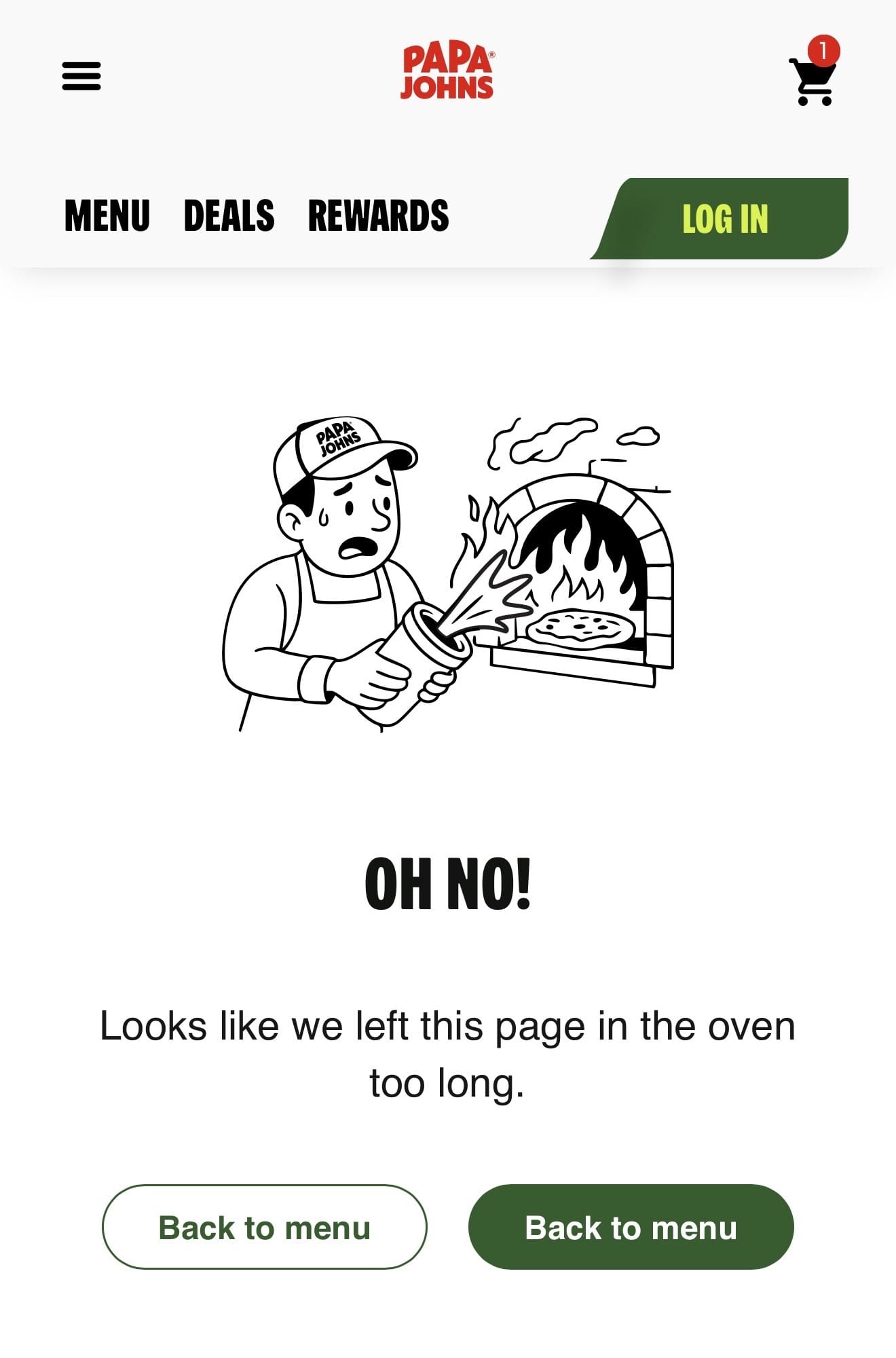
This is a fourteen dollar pizza. The friction is not an accident, and it is not a bug nobody got around to fixing. It is the new shape of the transaction. The company has decided, somewhere upstream of you, that whatever revenue is lost to the broken flow is less than the cost of the engineers who would have to fix it. The number on the spreadsheet pencils out. The pizza, statistically, gets ordered enough of the time. You are the friction-absorber. Congratulations on the role.
And no, walking into the store does not fix it. The in-store system is a different system, with a different menu, and the staff have no authority to bridge the gap because nobody upstream planned for one to exist. Even if they could help, would they? The frontline worker has not really pretended to care for the better part of a decade, and who can blame them. A broken app, no escalation path, and a wage that has not moved in eight years is not a deal anyone goes to bat for. The fallbacks have been severed at both ends: the system cannot make the order work, and the human in the system has stopped trying to. From the customer's seat the two are indistinguishable.
It is not one company
The same week, a subscription that has been worth its monthly fee for a year is finally ready for the bigger plan. The pricing page is gorgeous. The comparison table is dialed in. The Upgrade button is right there in the brand color, lit up, hovering politely. Click it. A spinner appears for a second, then nothing. The page sits there as if the click was a suggestion. Reload, log out, log back in, find the same button, click it again. Same nothing. The company is, in principle, ready to take more money. The company has not bothered to make sure the path by which the money arrives is operational.
Email customer support. There is no longer a phone number, because the phone number used to ring a desk where a person sat, and the desk has been closed. The form accepts the message. The auto-reply promises a response within two business days. Two business days pass. Four business days pass. Two weeks pass. The ticket is still listed as "open" in a portal nobody monitors. The support function has been, in the corporate vocabulary, transformed. In the customer vocabulary, it has been eliminated.
An Amazon package goes missing. Once upon a time this was a phone call. You called, a person looked it up, the person credited the account, the conversation took four minutes. Now the path to a human is buried under six screens of chatbot, and the chatbot is trained to resolve everything except your actual problem. When a person finally appears on the line, they ask for the order number, the card last four, the email on the account, the shipping address, the billing address, a second form of identification, and the answer to a security question set up nine years ago. Halfway through, a thought arrives unbidden: this is what a scam call feels like. The rational move becomes to abandon the conversation, return the product when it eventually shows up, and absorb the loss. The company "wins" the exchange on paper. The return is logged as a return, not a trust event. The line item that would capture what just happened does not exist.
Bridging the gap
There is a phrase for what the customer is now expected to do. The phrase, in the consultant decks and the internal memos, is bridging the gap. The customer bridges the gap that used to be filled by a junior support agent. The customer bridges the gap that used to be filled by a receptionist. The customer bridges the gap that used to be filled by a returns clerk, a billing specialist, a person whose entire job was knowing where things were and getting them un-stuck.
The corporate restructuring memo calls this AI-enabled efficiency, or modernization, or, if the writer is feeling brave, AI transformation. The customer experiences it as filling out forms for a company that used to know who they were. The labor did not disappear. It was transferred. The transfer was not negotiated, not disclosed, not compensated. The customer is now an unpaid employee of every company they do business with, and the job title is friction-absorber.
Bridging the gap is the polite name for an unpaid labor transfer. Everything else is decoration.
The executives love it because the metrics love it
Here is the part the rant has to take seriously, because dodging it would be dishonest. The strategy is winning. Stock prices are at all-time highs. Operating margins are expanding. The headcount cuts that produced the broken pizza app and the unanswered support ticket and the chatbot maze were announced in earnings calls as discipline, and the market rewarded the discipline with multiple expansion. By every number the executives report on, this is working.
It is working because the customers who quit are invisible. The person who tried to order the pizza, gave up, and ordered something else does not appear on any dashboard. There is no row in the data warehouse called nearly bought. The plan upgrade that did not happen because the button did nothing is not tracked as a lost upgrade. It is not tracked at all. The Amazon return that happened because the support call felt like a scam shows up as a return, which is a cost line everyone already expects, not as the trust collapse it actually was.
The customers who stayed, meanwhile, are filling out the forms. They are the data. The metric is built from them. The metric says everything is fine. The metric is a survey of the people who did not leave the building, conducted by the people who locked some of the exits.
The doctor's office stopped calling
Notice that this is no longer about pizza apps. The doctor's office no longer calls with test results. The portal sends a notification, sometimes. You are expected to log in, navigate to the right tab, find the result, and interpret it. If you do not, the result sits there. The receptionist who used to call and say your bloodwork came back, here is what the doctor wants you to do has been "freed up" for "higher-value activities," a phrase that means the position was eliminated and the work was given to you.
And it is not one portal. The primary care doctor has one. The lab has a different one, with a separate account and a separate password. Imaging has its own. The pharmacy has yet another. None of them share data in any way the patient can feel, so the patient becomes the integration layer, holding four open tabs and assembling a picture of their own health that no single provider has any responsibility to assemble. The cognitive load that used to live inside a clinical team has been quietly redistributed to the person least equipped to carry it: the one who, almost by definition, is not feeling well.
The customer is now performing medical record retrieval, on themselves, for the convenience of the practice. This is not a pizza app. This is healthcare. The friction transfer has moved up the value chain, and it is moving faster than the response to it.
The slow part is the trust
What looks like operating leverage is the consumption of an asset that does not appear on the balance sheet. Every interaction where the customer bridges the gap, eats the friction, abandons the cart, returns the product, gives up on the support ticket, that interaction is a small withdrawal from the stock of trust that was built over years and is being drawn down in quarters. The withdrawal does not register. The stock of trust is not a line item. The customer's silent decision to stop trying is not a metric. It is a decision made privately, with no exit interview, no churn dialog, no feedback form. The company never finds out.
So the strategy looks like genius. It will continue to look like genius for a while longer. The customers who have not quit yet have not quit yet, and the ones who have are not on any list. The earnings calls will keep being good. The decks will keep showing the curve going up. The consultants will keep selling the playbook to the companies that have not run it yet, because the playbook is the one that worked.
The thing about running down an asset you cannot see is that the discovery is always retrospective. The metric that finally turns over is the lagging one, the one that the executives report on, and by the time it turns over the customer has already been gone for two years. The chart looks flat right up until it falls off a table, because the chart was never measuring the thing that was moving.
The companies are not winning. They are eating their own seed corn and calling the meal an efficiency gain. The market is applauding because the market, too, is reading the metric the executives chose to publish. Everybody is looking at the same number. The number is not the business. The business is the trust, and the trust is being spent.
The pizza will keep not getting ordered. The support ticket will keep not getting answered. The test results will keep sitting in the portal. And somewhere in a boardroom, someone will say the word efficiency, and everyone will nod, and the stock will tick up another half percent, and the customer who used to bridge the gap will quietly walk off the bridge.
Comments
// Comments are reviewed before appearing. No spam. No noise.