The Cave That May Not Exist
The hills across the Nile from Maghagha are limestone, dry, and pocked with tombs. That much anyone can check. The ridge is called Jebel Qarara, on the east bank of the river in the province of El Minya, Middle Egypt, and people have been burying their dead in its caves for as long as anyone has kept records, and longer.
What happened in one of those caves, sometime around 1978, comes down to us through a single chain of testimony, and every link in it is soft. The journalist Herbert Krosney assembled the account twenty-five years later, in his book The Lost Gospel, from informants who would not give their names. As Krosney reconstructed it, a local farmer he calls Am Samiah, a name invented to protect him, led a few villagers up the ridge to a cave. Inside they found what the informants described as the skeleton of a wealthy man in a shroud. Beside it lay glass flasks from the Roman era and a white limestone box. In the box were books. The trade would later associate four manuscripts with the find; this story follows one of them.
No archaeologist ever saw the cave. No photograph of it exists. The date is a best guess, the inventory is secondhand, the finder's name is borrowed, and the people who could correct the record are dead or not talking.
One thing in it can be checked. Around the year 180, a bishop in Gaul named Irenaeus, cataloguing the errors of rival Christians, condemned a book he called the Gospel of Judas. He had found it in use among believers, a group later called the Cainites, who honored the figures scripture condemns. For nearly eighteen centuries after that, the title appears nowhere: no copy, no quotation, no reader who claims to have seen one. Then, around 1978, a battered Coptic codex surfaced in the Cairo antiquities trade, and one of the texts sewn into it carried that name. The book is the fact. It can be handled, photographed, carbon-dated, and it has been. The rest, the cave, the skeleton, the shroud, the box, is testimony.
The Name
Ioudas is the plain Greek dress of the Hebrew Yehudah, Judah, the patriarch Leah named in Genesis 29:35, "This time I will praise the LORD" (the wording is the ESV's; the root means praise). In the surviving records of Palestine from 330 BCE to 200 CE it is the fourth most common male name, 164 occurrences, behind Simon, Joseph, and Eleazar. The count is in Tal Ilan's Lexicon of Jewish Names in Late Antiquity, tabulated by Richard Bauckham. Its popularity is usually credited to Judas Maccabeus, the hero of the revolt commemorated at Hanukkah. Under an occupation, parents gave the name as a flag. That is solid.
The New Testament itself is crowded with the name: a second apostle called Judas, a brother of Jesus, a rebel, a host of Paul, a prophet. John has to write "Judas, not Iscariot" to keep two men straight at one table.
English split the word. One Greek name became "Jude" for the apostle, the epistle, the brother, and "Judas" for one bearer. Most other languages never built the firewall. A legend attaches here, and it is flagged as one: that St. Jude became patron of lost causes because the faithful feared a name that sounded like the other man's, and only the desperate prayed to him.
The name's extension is on the record early. Pope Gelasius I, in the fifth century, wrote that as Judas was called a devil and the devil's workman, "he gives his name to the whole race." Judah, Judas, Judea, Jew; the words share one root.
In his own language he was Yehudah, and by John's patronymic Yehudah bar Shim'on. Greek speakers said Ioudas. Nobody said the name the way we say it.
The Southern Voice
John, who has two apostles named Judas to keep apart, specifies this one as Judas son of Simon. In the Aramaic of his own table the name was Yehudah bar Shim'on. The surname is contested ground, but the oldest reading, and still the majority one, takes it as an address: ish Qeriyyot, man of Kerioth. Joshua's town lists put a Kerioth in the dry country ten or twelve miles south of Hebron, where the Judean hills fall away toward the desert, and a ruin called Khirbet el-Qaryatayn stands roughly where the list points, sheep and barley land at the edge of the wilderness. Whether anyone lived there in the first century is unproven; the map, at least, is real. If the surname is a hometown, he was the company's one southerner, among eleven men remembered as Galileans, from the lake country days to the north.
The distance was audible. Judean Aramaic kept its guttural consonants distinct, the sounds made in the throat, het and ayin, each in its own place; Galilean Aramaic ran them together, and Judea found this funny. The Babylonian Talmud preserves the joke: a Galilean goes through a market crying amar, amar, and is mocked, because the one blurred sound could mean wool or wine or a donkey or a lamb, and nobody can tell which he wants. At a table of eleven northern voices and one southern one, the blur ran in both directions every day, in every word with a guttural in it.
The record does say how the company ate. Luke lists its funders: women of means who provided for the group out of their own resources, among them Joanna, whose husband Chuza kept the household of Herod Antipas. Other people's money, then, carried in a common box, and John mentions, in passing, who carried the box. The Greek word for it is glossokomon. It first named the little case that held the reed mouthpieces of wind instruments, and the Greek scriptures had used it for the public collection chest King Joash set up for Temple repairs. A flute case doing duty as a treasury, in the keeping of the man from Kerioth.
During the festival week the company slept in Bethany, on the far slope of the Mount of Olives, and walked into the city each morning; Mark keeps the commute without comment, the late hour, the twelve going out to the village at dusk and coming back over the hill after sunrise. Twelve men and a teacher, fed and lodged through the most expensive week of the Jerusalem year, in a town swollen with pilgrims paying festival prices. A man who kept the purse for thirteen would have known that week in numbers: the price of lodging against the price of bread, the surcharge on changed coin, the cost of a lamb in a seller's market. The gospels do not record his arithmetic; when John needs to explain, later, what the others assumed the treasurer's errands were, the assumptions come in two kinds, buying for the feast and giving to the poor. Both were jobs. Both were his.
The feast itself could be read overhead. Passover begins on the fifteenth of Nisan, and in a calendar whose months begin at the sighting of the new crescent, the fifteenth night is the night of the full moon; the feast has never once fallen in the dark. From a rooftop in Bethany that week, the date hung in plain sight, filling a little more each evening.
The Dealer Robbed of the Book
The first documented price is 8,000 Egyptian pounds, about $2,400. A Cairo antiquities dealer paid it, around 1978, for the manuscripts that had come down out of the hills by whatever route they actually traveled. Krosney calls him Hanna Asabil; the first name is probably genuine, the surname is another pseudonym. Hanna was not a scholar and did not claim to be one. He called the codex "the book."
Around 1980, as the accounts have it, Hanna's entire stock was stolen out of his Cairo apartment, the book with it, and the haul was smuggled to Geneva. Two names attach to the theft and the recovery, the Greek dealer Nicolas Koutoulakis and the Athens collector Yannis Perdios, and the versions of who took what, who returned what, and on what terms do not agree with one another. Hanna himself told different stories over the years about where the book had come from. What the accounts hold in common is this: by 1982 he had recovered part of the hoard, the gospel included, and the men involved in its disappearance were men he had done business with.
That summer, Perdios began circulating large color photographs of the papyri. One set went to Frieda Nussberger-Tchacos, a Zurich antiquities dealer; another, late in 1982, to the papyrologist Ludwig Koenen in Michigan. Roy Kotansky examined photographs at the Getty. The object itself stayed out of sight. The pictures moved from hand to hand, and the people who saw them remembered them. Frieda would not own the codex for another eighteen years.
So the record of the book's first five years on the market, thin and contradicted as it is, shows this sequence: bought for 8,000 Egyptian pounds, stolen from its buyer, recovered in part, and offered onward.
The Verb
Every early source describes the act with the same Greek verb: paradidomi, to hand over, to deliver. It is a neutral word, used for handing over a prisoner, a deposit, a teaching, a city. Greek keeps a separate verb for treachery, prodidomi. No New Testament writer applies it to him. Of the roughly sixty New Testament references to Jesus being handed over, about two thirds concern this man's act, and every one uses the neutral verb. The noun prodotes, traitor, touches him exactly once, in Luke 6:16, a list of the Twelve set down some fifty years after the events. Mark's earlier list, at the same position, says "who handed him over." That is solid.
Romans 8:32 uses the verb with a different subject: God "did not spare his own Son, but handed him over for us all." Paredoken, the identical form. The Septuagint of Isaiah 53, translated well over a century before the arrest, already uses it of the Servant given up for sins.
Paul, the earliest Christian writer, never names him. The oldest surviving account of the supper reads "the Lord Jesus, on the night he was handed over": passive voice, no actor. The creed Paul transmits in 1 Corinthians 15 has the risen Jesus appear "to the Twelve." Some scholars read that arithmetic as a tradition that does not yet contain a defector; others answer that "the Twelve" was a fixed institutional title regardless of headcount. Both readings are live. Disputed, and printed as disputed.
William Klassen did the lexicography in his 1996 study, arguing that no ancient Greek text he examined, the Bible included, uses paradidomi to mean betray. He counted 293 uses of the verb in Josephus, a contemporary writing about wars full of traitors, and found none meaning betrayal. Reviewers summarized his charge as translators knowingly mistranslating; that phrase is theirs, not his. His larger conclusion, that the man was an agent carrying out an instruction, is disputed. The counts are not.
Where God is the subject, English Bibles turn the verb into "delivered up." Where this man is the subject, the same verb becomes "betrayed."
Tables
The Temple took its dues in one coinage only, and in actual coin, not in equivalent value, so changing money was an errand, one of the ordinary errands of a pilgrim company at Passover. The half-shekel was owed by every adult male; a company of thirteen men would have owed six shekels and a half, and dues at that scale were the box's business. The men who did the changing kept a fixed calendar, and the Mishnah preserves it: from the fifteenth of Adar the changers sat at tables in the towns of the country; from the twenty-fifth of Adar they sat in the Temple itself. It preserves their fee too, the kolbon, a surcharge of a silver ma'a on each exchange, about a twelfth of a half-shekel by the Mishnah's own reckoning, about four to eight percent of the money changed by modern estimates, with paragraphs of rulings about who owed it and when it doubled. The word the gospels use for the changers, kollybistes, is built from the same loanword. The men were named after their fee.
Around the tables ran the animal trade, and the pair of doves, the offering the law allowed to those who could not afford a lamb, is its documented scandal. The Mishnah records the price of a pair reaching a gold denar, twenty-five in silver, a month of a laborer's wages for the poorest sacrifice on the tariff, until Rabban Shimon ben Gamliel taught a leniency that collapsed the demand, and the price fell, the same day, to a quarter of a silver denar. One ruling moved the price a hundredfold. The Mishnah states the numbers and moves on.
Who sat above the trade is remembered in a lament the Talmud preserves from the Temple's last generations. It curses four high-priestly houses, each by its signature: woe is me for the house of Baitos and their clubs; for the house of Hanin and their whispers; for the house of Kathros and their pens; for the house of Yishmael ben Piakhi and their fists. Then the structure, in one line: the fathers were high priests, the sons were treasurers, the sons-in-law were overseers, and their servants beat the people with clubs. The house of Hanin is generally identified with the house the gospels call Annas: high priest for nine years, deposed by Rome and never out of power, five sons in the office after him, and a son-in-law, Caiaphas, holding it that Passover.
Into this economy, early in the week, Mark puts the overturning. Jesus entered the Temple, drove out the sellers and the buyers, overturned the tables of the money changers and the seats of the dove sellers, stopped the carrying of goods through the courts, and taught, in words stitched from two prophets: my house shall be called a house of prayer for all the nations, but you have made it a den of robbers.
A changer's table going over is a specific event: coin sorted by weight and issue, stacked for counting, scattering across pavement in front of a festival crowd. The damage in silver was countable on the spot. The other ledger, the one the lament keeps, ran in clubs, pens, fists, and whispers, payable to houses whose sons kept the treasuries and whose sons-in-law kept the courts.
Mark does not count the coin on the pavement. He does not say where the company's own treasurer stood that afternoon, or what a man responsible for a box of other people's money did while loose silver rolled between the feet of the crowd. He gives the tables going over.
Thirty Minutes, Three Shoe Boxes
On May 15, 1983, three Americans walked into a Geneva hotel room to see the merchandise. Stephen Emmel was a graduate student in Coptic studies, thirty years old, sent by James M. Robinson, the general editor of the Nag Hammadi library in English. With him came Ludwig Koenen, the Michigan papyrologist who had seen the photographs the year before, and the biblical scholar David Noel Freedman. Robinson's account adds a fourth visitor, Freedman's associate Astrid Beck; the other accounts keep the three. Robinson himself was not in the room; Emmel carried his commission. Hanna, as Krosney tells it, was among the sellers.
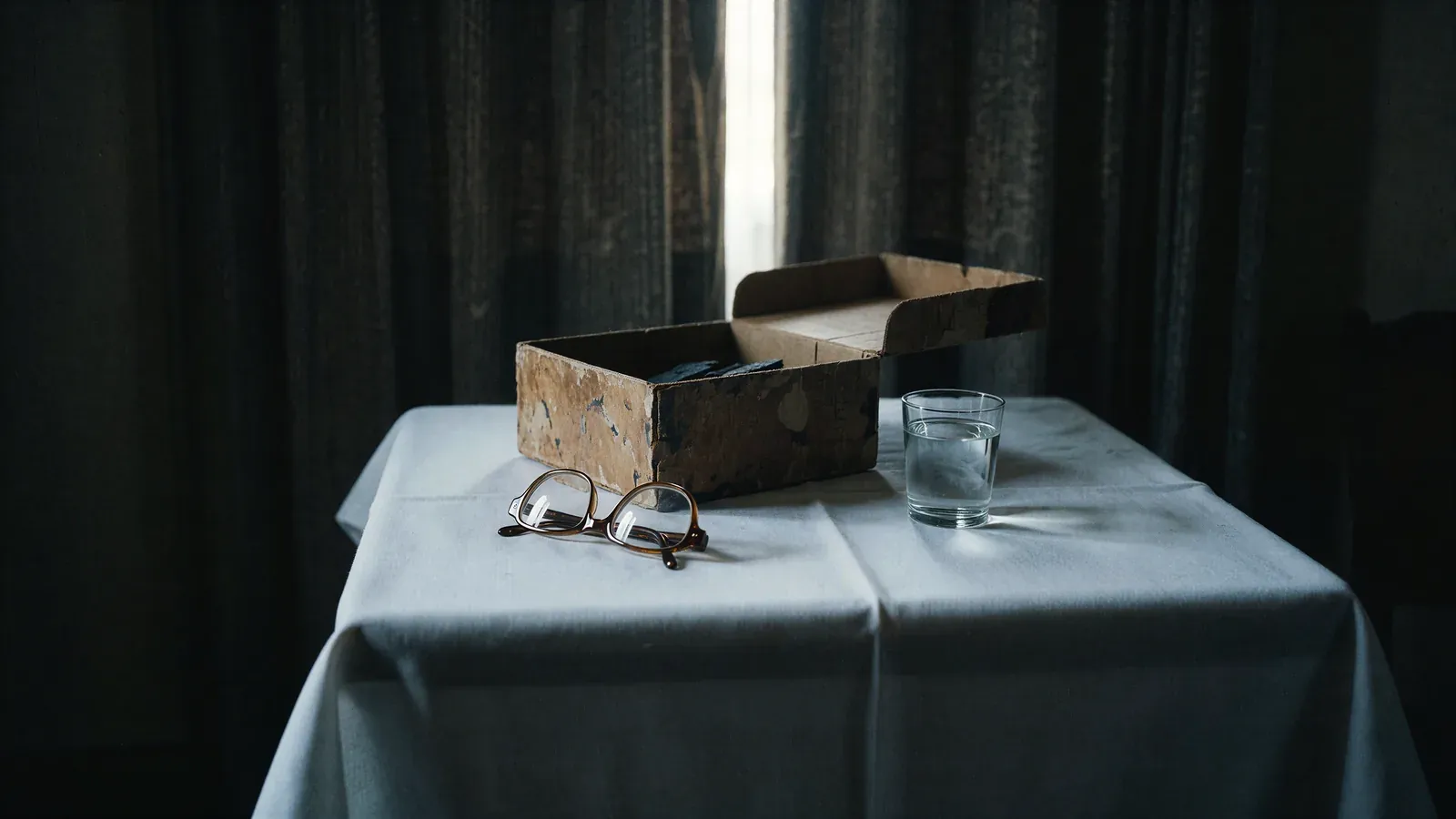
What the sellers produced was, in Emmel's later description, effectively three shoe boxes. Inside were papyri wrapped in newspaper: four manuscripts, an Exodus manuscript, a copy of the Pauline Epistles, a Greek mathematical treatise, and the papyrus codex of Gnostic texts. The visitors were given about thirty minutes with them, on the sellers' conditions: no photography and no notes. Emmel lifted the leaves with tweezers, turning what he could, reading what the light allowed. The description of the boxes is his; so is the count of the minutes. Half an hour of tweezers and newspaper was the whole of the scholarly access granted to the collection, and it stayed the whole of it for the next seventeen years. What he saw in that half hour was damaged but substantially whole. By his later account the Gnostic codex still ran to some thirty leaves, brittle at the edges but legible and largely in sequence, and he recognized its importance on sight, of a class with the Nag Hammadi manuscripts he had spent his career editing.
The ask is preserved in the exact words of Emmel's report: "The owner asked $3,000,000 for the entire collection." The buyers had nothing near it. Emmel had come authorized to offer money connected to Southern Methodist University, on the order of $50,000; the accounts of what the team could actually raise run between $50,000 and $100,000, and no two of them agree on the figure. The number the sellers wanted was sixty times the number Emmel was carrying. There was no deal to be made, and everyone in the room knew it within the half hour.
While the two sides ate lunch, Emmel slipped away and wrote down everything he could remember of leaves he had been allowed to touch but not record: what the collection contained, what condition it was in, what the texts appeared to be. The notes were composed from memory, at speed, while the dealers had their meal. The sellers kept the boxes.
His formal report, addressed to the would-be buyers, went out in June 1983. "I strongly urge you to acquire this Gnostic codex," he wrote. "It is of the utmost scholarly value, comparable in every way to any one of the Nag Hammadi Codices." He described the physical state of the leaves and prescribed the remedy: the leaves "will need to be conserved between panes of glass," and "it would require about a month to reassemble the fragments." The report survives; National Geographic printed it whole in the 2007 critical edition of the text it describes.
The report also contained this: the codex included "a dialogue between Jesus and his disciples (at least 'Judas' is involved)," similar in genre, he wrote, to the Dialogue of the Saviour. Emmel had not seen a title. Judas was a common name in the early Christian record, and several men bore it in the first two Christian centuries; the one whose dialogues with Jesus circulated in books of this kind was Judas Thomas, the apostle of the Syrian tradition. That is the Judas Emmel assumed he had held.
Four Drafts
Read in order of composition, the gospels are four datable drafts.
Mark, written around the year 70, gives no motive. The man goes to the chief priests first; the money is their idea, offered only after he arrives: "When they heard it, they were pleased and promised to give him money." No sum is named. No death is narrated.
Matthew, a decade or two later, adds the outstretched palm: "What will you give me?" Matthew is the first to name a sum, thirty pieces of silver, and the only gospel to narrate remorse, returned coins, and a hanging.
Luke, in the same generation, adds a cause: "Then Satan entered into Judas called Iscariot."
John, around the turn of the century, adds a thief who kept the common purse and pilfered from it, and, in Jesus's own mouth, "a devil."
Gary Greenberg states the trajectory in one sentence: "As one moves through the Gospels in the order of creation (Mark, Matthew, Luke and John) the image of Judas Iscariot, the alleged betrayer of Jesus, becomes increasingly negative." The sentence is solid. What it implies, invention or embellishment of a real man, is where the scholars divide, and both positions have serious names behind them.
One more pair of columns. In Matthew 19:28 Jesus promises the Twelve, this man present and counted, that they "will sit on twelve thrones, judging the twelve tribes of Israel." E. P. Sanders judges the saying authentic on grounds of embarrassment: no later Christian would invent a throne for this man, so the promise likely predates the case against him. Strong, but disputed. Luke's parallel (22:28-30) keeps the thrones and keeps the twelve tribes and drops the number of thrones. Greenberg reads a later hand removing one chair. That reading is disputed, and labeled so here. The two verses sit side by side in any synopsis: twelve thrones in Matthew, thrones in Luke.
The Whisper House
Mark gives the walk one sentence. Judas Iscariot, one of the twelve, went to the chief priests to hand him over to them. No summons is recorded, no approach from the other side, no intermediary. He goes to them, up into the city, on his own feet. That is the whole of the earliest report.
Mark does record what the walk solved. Two verses earlier, the chief priests and the scribes are looking for a way to arrest Jesus by stealth, and ruling out the festival itself: not during the feast, or the people may riot. A public teacher, surrounded by holiday crowds all day, sleeping outside the city at night. Luke states the value of the man who walked in flatly, as logistics: he consented, and looked for an opportunity to hand him over to them away from the crowd. Anyone in Jerusalem could point the teacher out at noon.
Where the chief priests lived is known ground. Their quarter was the Upper City, the western hill that looks down across the valley at the Temple, and excavation under the modern Jewish Quarter has uncovered the kind of house the walk ended at: a mansion of six hundred square meters, reception rooms frescoed in the fashion of Pompeii, imported tableware, vessels of turned stone, which by rule cannot contract impurity, and ritual baths cut into the rock beneath the floors. In the ash of the house next door, burnt in the year 70, the diggers found a stone weight inscribed "of bar Kathros," one of the four families the Talmud's lament curses by name. The lament assigns each house its instrument, and the instrument of the house of Hanin, the family the gospels call Annas, is the whisper. If the business was done in that quarter, the lament supplies the register it was done in.
Matthew alone names a sum and stages a payment, and he stages it on a scale: they weighed out to him thirty pieces of silver. Weighing was the Temple's usage, and the Temple's sums were payable by rule in the silver of Tyre, the most reliable coin in the eastern Mediterranean, fourteen grams to the shekel and better than nine parts in ten fine. Tyre struck it for nearly two centuries, and every strike carried the face of the god Melqart on one side and an eagle on the other, ringed by the legend "of Tyre the holy and inviolable." The only money pure enough for the sanctuary wore a foreign god on its face.
The sum can be laid against the period's other numbers. A Tyrian shekel was a tetradrachm, four denarii, and a denarius was a day's wage in the fields; thirty shekels comes to a hundred and twenty working days, about four months of a laborer's year, and a little under a pound of nearly pure silver. One shekel covered the half-shekel dues of exactly two men, so the sum equals the annual Temple tax of sixty. It would buy a small field. And the same paragraph of the Mishnah that fixes the Temple's coinage lists the sum's oldest use, carried forward from Exodus: thirty shekels of silver is what the owner of an ox pays when the ox gores another man's slave to death. The payment goes to the slave's master. The law has no payment for the slave.
One working term of the arrangement survives, preserved inside the sign Mark says was agreed in advance for the arrest. The sign was settled before the night it was used, and an instruction traveled with it: the man, once marked, was to be led away safely. Of everything that may have passed between Yehudah and the priests, "lead him away safely" is the only term on record.
Mark hangs a date over the whole passage: it was two days before the Passover. The silver, by Matthew's account, was already weighed and handed across. The city was still filling. The moon over the Upper City was two nights short of full.
Hicksville
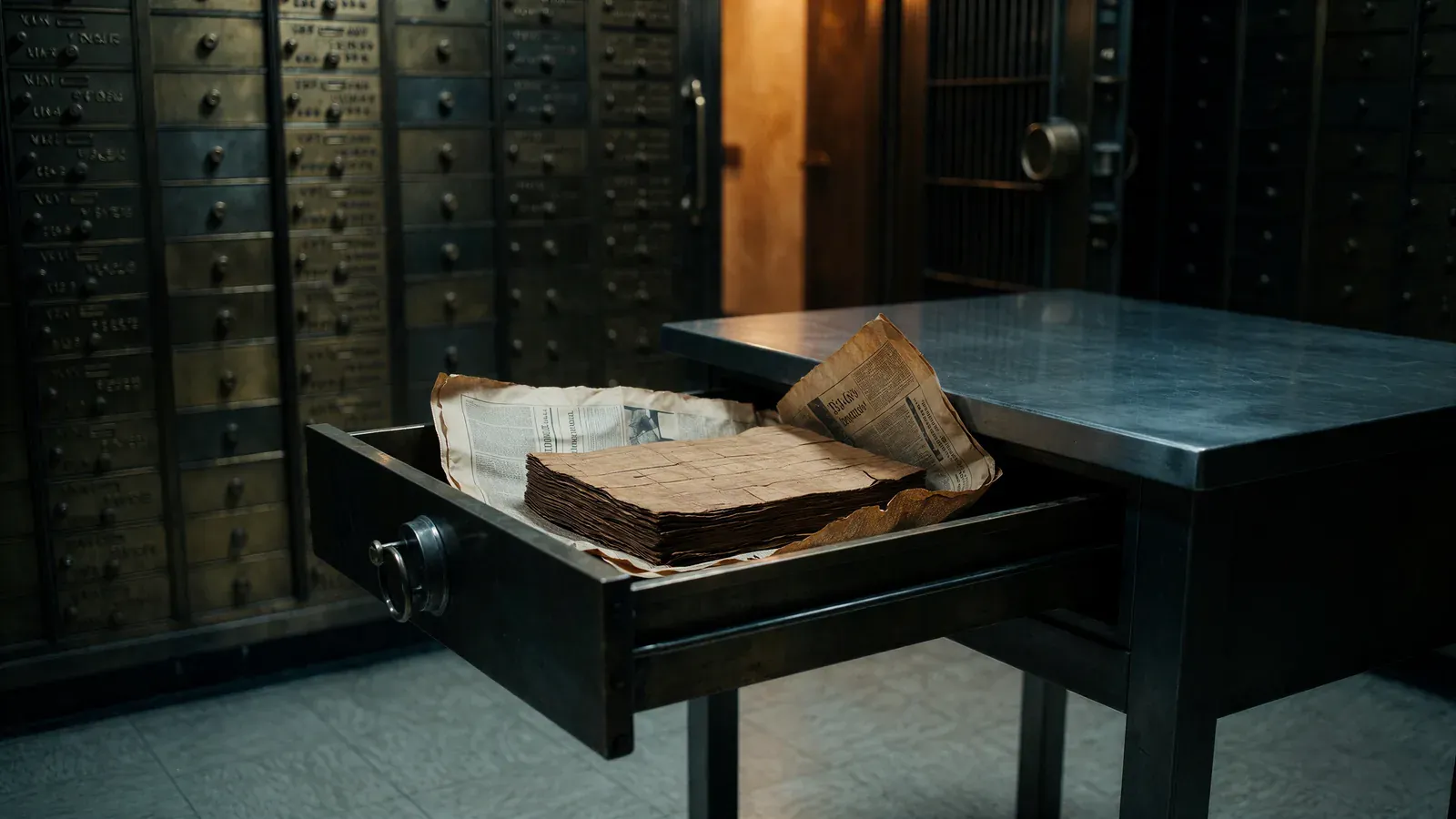
In 1984 Hanna flew to New York with the codex and locked it in a safe-deposit box at a Citibank branch in Hicksville, Long Island. He went home to Cairo and, over the years, intermittently looked for a buyer at his price. None came. The book stayed where he had left it.
The vault held ordinary East Coast air, damp in summer, dry in winter, cycling with the seasons, sixteen years running, 1984 to 2000. The branch was an ordinary suburban bank; a safe-deposit box has no climate control. Outside the vault the Reagan years passed, then the Bush years, then the Clinton years. Inside, by every account, no one touched the book at all; no account so much as records the box being opened, and the one word the accounts add to untouched is moldering. The large color photographs from 1982 stayed in circulation, and through the Hicksville years the photographs were what anyone outside the vault had.
The book's condition was recorded on both sides of the vault years, once going in and once coming out, and the ledger reads as follows. In 1983, the codex comprised some thirty leaves, sixty pages, damaged but, in Emmel's phrase, "still in pretty good condition." By 1999, of at least thirty-one original leaves, thirteen survived as coherent blocks. The rest had come apart into more than a thousand pieces. The next scholars to see it described it as in very bad condition.
The Counter-History
Classical rabbinic literature never mentions him. The Talmud's disputed Yeshu passages name five disciples: Mattai, Nakai, Netzer, Buni, Toda. No Yehuda stands among them, and no betrayer figure exists anywhere in the account, because in that telling the court does its own work in daylight, with a crier going out for forty days first. The silence is solid.
When medieval Jewish literature finally tells his story, in the Toledot Yeshu, he is the community's champion. The frame matters and is stated plainly: this is the internal counter-history of a powerless minority inside Christendom, legend and not doctrine, quoted here from critical scholarship and clearly labeled public-domain editions. In it the sages send Yehuda Iskarioto into the Temple to learn the Ineffable Name. Jesus lifts his arms like an eagle's wings and flies; the elders tell Judah to pronounce the letters and fly up after him; the two grapple in the air and neither can force the other down, the Ineffable Name being equally with both. Judah breaks the stalemate by spending his own purity. In the Strasbourg manuscript he "did a vile thing: he urinated on Jesus, so that he was made unclean and fell to the earth, and Juda with him," translated from Krauss's 1902 German rendering of the manuscript. The Name cannot dwell with impurity; he accepts defilement to bring both fliers down. In the Wagenseil version he first makes the elders carry the sin, in Baring-Gould's 1874 translation: "The guilt be on us; but do thou make the effort and succeed."
The dating gets its own label. The earliest witnesses to a story of this type, two archbishops of Lyon writing around 826 and 846, describe it in detail with no Judah in it. The flying champion is firmly datable only from a Latin translation of the late thirteenth century. The dates are solid; what they imply about the hero's growth is inference.
Samuel Krauss, who founded the field, put the two ledgers in one sentence in 1902: he who in the Christian account is a traitor appears to the Jews as a pious and meritorious man, the savior of his people.
The Day of Slaughter
By the fourteenth of Nisan the city had taken in more people than it could hold. Josephus describes festival crowds camped in tents on the ground around Jerusalem; every rentable roof and courtyard had its tenants; and the law of the lamb organized the crush into arithmetic, companies of no fewer than ten and as many as twenty registered to each animal. A generation later a Roman governor took the measure of a Passover by counting carcasses; Josephus preserves the census, 256,500 lambs, and the computation built on it, two million seven hundred thousand celebrants. Modern historians reject the total as impossible for the city's ground and water, and put the festival crowd in the low hundreds of thousands, agreeing only that Jerusalem multiplied severalfold that week.
The afternoon of the fourteenth is documented almost hour by hour. The Mishnah moves the daily offering early, slaughtered at half past the eighth hour, about half past two in the afternoon, and offered an hour later, to clear the altar; then the Passover lambs came in three great companies, the first entering until the Temple court was full and the doors were shut behind them. Shofar blasts marked the stages. The priests stood in rows holding bowls, one row all of silver and one row all of gold, the rows never mixed; the bowls passed hand to hand down the lines, and the priest nearest the altar dashed each bowl's blood in a single throw against its base. Over all of it the Hallel was sung, and if the singers finished before the slaughtering did, they began it again.
Someone in every company carried the money for the rest of it: the unleavened bread, the wine, the bitter herbs, the room. In this company those errands were the box's business. Mark has the room already spoken for, found by two disciples who followed a man carrying a water jar and were shown a large upper room, furnished and ready. The purse's work that day was its ordinary work, done on the one day of the year when the entire city was doing it at once.
By Matthew's account there was other silver in his keeping that week, weighed to him by the chief priests. Matthew is also the writer who reports what became of it, and in his report the sum comes back to the chief priests intact, all thirty pieces, days after the weighing. A man carrying a common box and a private sum, and able at the end to hand the private sum back whole, had kept the two apart, coin from coin, the entire time. Matthew does not say where he kept it, or how. Matthew's arithmetic only requires that he did.
At sunset the fourteenth ended and the feast began. The fifteenth of a lunar month opens with the full moon rising opposite the setting sun, and from inside Jerusalem that horizon is the ridge of the Mount of Olives. The moon came up over the hill with the oil press on its western slope, and over Bethany behind it, while the lambs went onto the fires.
The Name and the No
In April 2000, Frieda Nussberger-Tchacos bought the codex from Hanna and ended its sixteen years in the box. She was a Zurich-based antiquities dealer, born in Egypt, of Greek descent, and she had first seen the book in Perdios's photographs eighteen years before. The price she paid was not disclosed. Asked later about the rumored $300,000, she said the figure was "wrong, but in the neighborhood."
She deposited the codex at Yale's Beinecke Rare Book and Manuscript Library, where the curator Robert Babcock received it for examination. Within days, the book Irenaeus had condemned by title around the year 180 had its title read again. Who read it first is told two ways: Krosney's fuller account credits the Yale Coptologist Bentley Layton, while the shorter version has Babcock himself delivering the news, "This is unbelievable material; I think it is the Gospel of Judas Iscariot."
What the title matched was on the record. Irenaeus had written of the book's users that "they declare that Judas the traitor was thoroughly acquainted with these things, and that he alone, knowing the truth as no others did, accomplished the mystery of the betrayal," and that "they produce a fictitious history of this kind, which they style the Gospel of Judas." The codex on the Beinecke's table held four texts sewn together: a Letter of Peter to Philip, a version of the First Apocalypse of James, the fragmentary Book of Allogenes, and, on codex pages 33 to 58, the text carrying the condemned title.
Frieda later named the codex for her father, Dimaratos Tchacos, and it has been Codex Tchacos ever since. Later still she said, "I think I was chosen by Judas to rehabilitate him." Scholars close to the project, Bartlett reported in the Chronicle of Higher Education, tended to roll their eyes at that framing.
Yale kept the codex about five months, into the autumn of 2000. Then the library declined to purchase it, citing unresolved questions about its provenance. The examination that identified the lost gospel and the decision to refuse it rested on the same file: a book with no findspot, no export papers, and a trail of hands.
The Calendar
The Didache, a church manual dated between about 50 and 120, commands a fast: "fast on the fourth day and the Preparation." Wednesday and Friday. The only motive given is to differ from "the hypocrites," who fast Monday and Thursday. No name is attached to Wednesday.
The name arrives later, in stages that can be dated. The Didascalia Apostolorum, a third-century Syrian church order, is commonly cited as tying the week's fasts to the passion chronology and putting the arrest on the fourth day. Peter of Alexandria, around 306, gives Wednesday its explicit reason: "because on it the Jews took counsel for the betrayal of the Lord." By about 380 the Apostolic Constitutions rewrite the Didache's own sentence with the name inside it: fast on the fourth day "because on the fourth day the condemnation went out against the Lord, Judas then promising to betray Him for money." The same command, two centuries apart, with a man installed as its reason. All of this is solid, and Wednesday remains a year-round fast day across the Orthodox world.
The liturgy carries the name as well. The Holy Thursday kontakion carries it in a pun, doulos kai dolios, the slave and the deceiver. And among the prayers said before receiving communion, printed in the service books, stands this sentence: "I will not speak of Thy Mystery to Thine enemies, neither like Judas will I give Thee a kiss, but like the thief will I confess Thee." It is recited before every reception, at every liturgy; in wide parish practice the whole congregation says it aloud.
The Morsel
The meal was eaten reclining, after dark, in the borrowed upstairs room. John's account keeps the table's geometry only in glimpses: one disciple, the one John calls the disciple whom Jesus loved, lay close enough against Jesus to lean back and ask a question quietly; Peter sat far enough away that he had to signal the question with a motion of his head. Mark's account of the same meal has the trouble announced to the whole table: one of you will hand me over, one who is dipping with me into the dish. Both tellings stand on an old line of psalm, the close friend who ate my bread and lifted his heel against me; Mark's dish alludes to it, and John has Jesus quote it at the table before the bread is dipped. Mark's disciples grow distressed and answer one after another, each with the same words, "Surely not I?" Thirteen men around one dish, and the saying pointed at no one that any of the others could name. Mark's table also hears the second saying, and it lands on no one identifiable either: the Son of Man goes as it is written of him, but woe to that man by whom the Son of Man is handed over; it would have been better for that man if he had not been born. Both sayings sat in the room. The meal went on.
In John the question reaches Jesus privately, from the disciple lying nearest him, and the answer is given with bread. It is the one, Jesus says, to whom I will give this piece of bread when I have dipped it; and he dipped the piece of bread, John's word is psomion, a morsel, and gave it to Judas son of Simon.
The commentary tradition, as far back as it runs, reads a host dipping a morsel and handing it to a guest as a gesture of honor, the host singling out a man for favor at his own table. Some commentators add the inference that a morsel passes only as far as an arm reaches, which would put the man from Kerioth beside the host, possibly in the honored place at his left. The seating is reconstruction. What the text gives is the bread, dipped and carried from one hand to the other where the table could see it.
Then the sentence, four words in John's Greek, ho poieis poieson tachion. "What you are about to do, do quickly." It is grammatically an imperative; what it commissioned, the text does not say. John states plainly that no one at the table knew what it meant. No one is recorded asking him anything. The others assumed one of the treasurer's two standing errands, and John records both without deciding between them.
Later scholarship, Jeremias chief among it, fills in the night's background: on Passover night the Temple gates were said to be opened from midnight, and giving to the poor belonged to the feast's own customs, so a man carrying the common box had better reasons to be out after dark than any other night of the year supplied. The streets he went out into were the fullest of the Jerusalem year, every house holding its company at table, the smoke of the roasting fires standing over the roofs, the moon at full above them.
Eleven men watched the keeper of the box rise from the feast and leave. Nobody followed him.
In the whole scene John gives him nothing to say, and closes it in one line. He took the piece of bread and went out at once. And it was night.
The Freezer
Yale's refusal left Frieda holding the book. In September 2000 she sold it to Bruce Ferrini, a dealer in manuscripts and antiquities in Akron, Ohio, for $2.5 million; she had bought it that April for a sum in the neighborhood of $300,000, and the new figure was the highest price yet attached to the book. Ferrini paid with two postdated checks of $1.25 million each.
Ferrini put the codex in a freezer. The physics ran one way. Papyrus holds water, and the leaves had been damp for years in the Hicksville box; in the freezer that water crystallized, and as it expanded it ruptured fibers that had held together for seventeen centuries. In the thaw, the plant's own sap migrated through the leaves and carried ink with it. The accounts of the result agree in substance. One describes the degradation as dramatically accelerated, the ink and sap separating from the fibers of the papyrus; the Krosney-derived version says the leaves were weakened to the point of crumbling. The freezer was the single most destructive event in the book's recorded life.
The checks could not be covered, and in February 2001, under a settlement engineered by Frieda's Swiss lawyer, Mario Roberty, and under pressure that included a public campaign on the website of the dealer-watchdog Michel van Rijn, Ferrini returned the codex, though not all of it: fragments stayed behind in Ohio, and the withholding was secret. Five years would pass before anyone outside Ohio learned of it. He had held the book about five months, September to February.
Ferrini's handling of other manuscripts from the same hoard is documented. The three companions from the shoe boxes, the Exodus manuscript, the Pauline Epistles, and the Greek mathematical treatise, were broken into leaves and fragments and sold piecemeal, through dealers and, in part, on eBay; the University of Pennsylvania papyrologist Robert Kraft documented the eBay sales in a 2007 report. Had the checks cleared, the Gospel of Judas would have been Ferrini's, to handle as he handled the others.
From Frieda the codex passed to the Maecenas Foundation for Ancient Art in Basel; the foundation was Roberty's own, and it would sponsor the restoration and eventual publication. The work would begin the next year in Switzerland. Frieda was reportedly entitled to between $1.5 million and $2 million from the codex's eventual revenues; the figures vary by account. What reached Basel was a book in more than a thousand pieces.
The Kiss
Four documents record the arrest. The gesture at the center of it will not hold still across them.
In Mark, the plan reads as tradecraft. He gives the arrest party a syssemon, a prearranged signal: "Whomever I kiss, he is the one; seize him and lead him away safely." The planned verb is phileso, a kiss. The delivered verb, one verse later, is katephilesen, the intensive compound: kissed fervently, or repeatedly. The escalation from plan to act is in Mark's own word choice. The Cambridge Bible glosses it "kissed him with fervour or repeatedly"; Vincent's Word Studies calls it "an emphatic, ostentatious salute"; Bengel reads "kissed Him repeatedly"; Meyer insists the compound keeps its force "as much as in classical Greek." Plutarch uses the same compound for Alexander the Great publicly kissing his beloved Bagoas in the theater.
The compound has a concordance. Kataphileo occurs six times in the New Testament. Twice it is this scene. The other four: the weeping woman at Jesus's feet, that same woman cited to a host who had offered no kiss, the prodigal son's father running down the road, the Ephesian elders weeping over Paul at a last parting. Every use outside the arrest is an act of overwhelming love or grief. The list is solid.
In Luke, he draws near "to kiss him," an infinitive of purpose, and the text never says the kiss landed; the narrative cuts straight to the question, "Judas, are you handing over the Son of Man with a kiss?" That the kiss hangs unfinished in Luke is what the text shows. That Luke left it unfinished deliberately is an interpretation, and is labeled one.
In John there is no kiss at all. Jesus steps forward and identifies himself; the cohort draws back and falls to the ground; the man's entire recorded action at the arrest is one verb: he "was standing there with them."
The standard explanation, that a kiss was simply how a disciple greeted his rabbi, is a commentary-tradition assumption with no first-century attestation. Attested kisses in Jewish sources cluster around reunion, farewell, and honor: Esau on Jacob's neck, Samuel at Saul's anointing, David and Jonathan in the field. The custom claim is the disputed part; the clustering is solid.
One earlier kiss is on the record. Second Samuel 20: Joab takes Amasa by the beard to kiss him, asking "Are you well, my brother?", with a dagger in the other hand.
The Grove
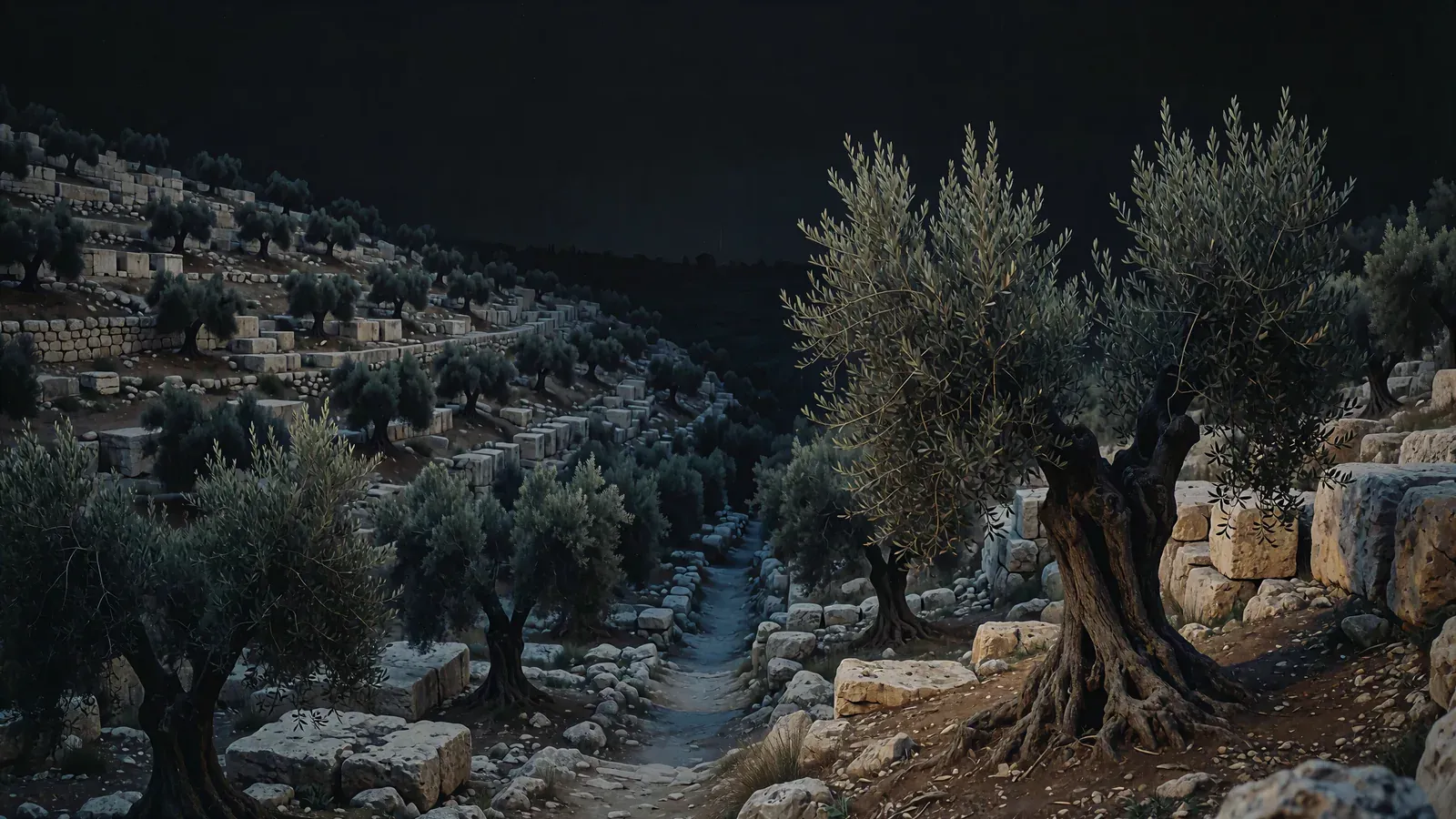
After the meal the company went out of the city to the east, down into the Kidron. John names the valley by its hydrology, a winter torrent; at Passover, in spring, it carried a trickle at most. The path out of it climbed through a necropolis. The Mishnah orders graves marked with whitewash before the festival, so that pilgrims moving in the dark would not touch a tomb unawares and carry corpse-impurity into the feast, and the tombs of the Kidron slope had been freshly chalked accordingly. The night was the fifteenth of Nisan; the moon was full. The company walked up between whitewashed tombs shining on both sides of the road.
The place they stopped at was a working property. Mark calls it a chorion, a plot or estate, named Gethsemane; John calls it a kepos, a garden or orchard; the name itself is Aramaic, gat shemanim, oil press. Olives are pressed in autumn. In spring the press stood idle, a sheltered place on the mountain's lower slope with equipment nobody was using. The eight old trees in the walled garden shown to pilgrims today have been carbon-dated to the Crusader centuries, three of them tested, all offshoots of a single parent plant; olive trees regrow from their roots, so the rootstock may be older, and no one claims a standing first-century trunk. Luke says going there at night was Jesus's custom that week. John says the rest: Judas, who was handing him over, also knew the place, because Jesus often met there with his disciples.
There is a reconstruction, built from later rabbinic sources, of why the company was on that slope at all instead of in its beds in Bethany: the Passover night was to be spent within an enlarged festival district of the city, and the line took in the near side of the Mount of Olives while leaving Bethany out. If the rule held in that generation, then on this one night of the year the company could not walk home, and anyone who knew their habits knew exactly where they would be.
The column that came for them is itemized in John: the speira, his word for a Roman cohort, with the definite article; officers of the chief priests and the Pharisees; weapons; lanterns and torches. A tribune appears at the moment of seizure. Whether Roman troops really marched that night, or John has enlarged a Temple posse, is argued both ways. The officers, at least, belonged to a documented force. The Mishnah describes the Temple's night watch: priests at three stations, Levites at twenty-one more, and an officer of the Temple Mount who made his rounds with lighted torches carried before him, empowered to beat any watchman found asleep and to burn his cloak where he lay. The lighting is listed only in John.
The seizure is told four ways. In Mark and Matthew he comes forward, says Rabbi, and kisses him, and Matthew alone records what is said back: Hetaire, eph' ho parei. Hetairos is comrade. The rest of the clause has never settled into English, because the Greek supports both a command, do what you came for, and a question, why have you come. It is the last thing Jesus says to him in Matthew. John, who reports no kiss, gives the fullest scene: Jesus steps forward, asks the column whom they are seeking, answers, I am he, and the men draw back and fall to the ground. He asks a second time and attaches a condition, that if he is the one they want, the others are to be let go. And Judas, John notes, was standing there with them. The verb is pluperfect. He had taken his place in the column, and he held it.
Then the seizure, fast and in fragments. One of those standing by drew a sword and took off the ear of the high priest's servant; Mark leaves the swordsman anonymous, and John, writing decades later, names him Peter and names the servant Malchus. The disciples ran. A young man was caught by the linen cloth he had slept in, left the cloth in their hands, and ran naked into the dark. The column closed around the prisoner and led him away, down through the chalk-white tombs and up into the city, to the house of the high priest.
The Deaths
Matthew records the only confession in the passion narratives: the man repents, carries the silver back, and says, "I have sinned; I handed over innocent blood," his verb paradidomi even inside the confession, and the chief priests answer, "What is that to us? See to it yourself." Peter, who denied three times that same night, is restored afterward with three questions on a beach.
The price came with a citation. Matthew credits "Jeremiah the prophet" for the thirty pieces, but the text he quotes is Zechariah 11:12-13, where a shepherd's insulting wages are weighed out, thirty shekels of silver, and thrown to the potter. Nothing matching the quotation exists in Jeremiah; the misfiling is acknowledged across the commentary literature. Thirty shekels was already a fixed figure in Torah: Exodus 21:32, what an ox's owner pays when the ox kills another man's slave.
The death is recorded three ways, incompatible.
Matthew: he hangs himself. The priests, refusing blood money for the treasury, buy a potter's field with it, called the Field of Blood because it was bought with the price of blood.
Acts: he buys the field himself with the money, falls headlong, bursts open in the middle, and his bowels gush out. The field is called the Field of Blood because his blood was spilled on it. The same field, Akeldama, with a different buyer, a different death, and a different etymology.
Papias of Hierapolis, writing in the early second century, around 100 to 130, preserves a third: "his body having swollen to such an extent that he could not pass where a chariot could pass easily, he was crushed by the chariot, so that his bowels gushed out." A longer recension of the same fragment has him die bloated on his own land instead, the ground left deserted and stinking; which recension is original is disputed. Neither contains a rope.
Five Years of Tweezers, Eight Months of NDA
The restoration fell to Rodolphe Kasser, the Swiss Coptologist who had made his name editing the Bodmer papyri. The bench work belonged to the conservator Florence Darbre of the Fondation Martin Bodmer, working with the Coptologist Gregor Wurst: more than a thousand fragments, sorted, matched, and set between panes of glass over roughly five years. Bartlett later put the problem in domestic terms: tear ten double-sided pages to bits, throw a third of the pieces away, shake the box, and rebuild. In 1983, Emmel had estimated the reassembly at about a month.
In July 2004, Kasser announced the codex's existence at the Congress of Coptic Studies in Paris. In January 2005, the University of Arizona's accelerator mass spectrometry lab radiocarbon-dated papyrus and binding samples to between 220 and 340 CE, a result commonly summarized as 280 CE, plus or minus sixty years. A January 2006 ink analysis came back consistent with third-century Egypt. The arithmetic of those findings is short: the book is authentic and ancient, and nearly all of its ruin dates from the last twenty-five years.
National Geographic bought rights to the project from the Maecenas Foundation, for about a million dollars by Bartlett's reporting; the Society's Terry Garcia put it at "low seven figures." In December 2004, by Ehrman's account, the Society convened experts in Geneva and asked them to sign nondisclosure agreements before they saw anything; among them were Bart Ehrman, flown in and handed the paperwork before the viewing, and Emmel, examining in ruins the codex he had last handled with tweezers in 1983.
The translation ran on a much shorter schedule. Marvin Meyer, a Coptic scholar at Chapman University, got a phone call inviting him onto a project the callers declined to describe. "We can't tell you," was the reply, and when Meyer asked whether he was really being invited to commit to a project sight unseen, the answer was "Exactly." He signed the nondisclosure agreement first. Then he translated the 26-page Coptic text almost nonstop for a week, in a Washington office with dictionaries and the codex. From Meyer's hiring to the public announcement took about eight months. National Geographic later objected that the translation took years, not months; Bartlett answered that Meyer himself had confirmed the eight-month figure.
The secrecy drew fire of its own, some of it from inside. No facsimile was shared while the work ran, and high-resolution images stayed out of other scholars' hands until 2008, against the spirit of a 1991 Society of Biblical Literature resolution born of the Dead Sea Scrolls monopoly. Meyer said of the arrangement, "We have at times gnashed our teeth to work with them... We have found things to be highly irregular." The documentary's producers, he said, pressed him to state on camera that one particular cave was the cave. Of the filming: "The pressure to sacrifice truth for drama was constant."
On April 6, 2006, National Geographic presented the restored codex and its first English translation at a press conference in Washington. On April 9, days before Easter, the documentary aired to four million viewers, then the second-highest-rated program in the channel's history, behind a September 11 documentary; the translation volume went on to some 300,000 copies in print. The line the world took away was spoken by Jesus to Judas on page 56 of the codex: "you will exceed all of them. For you will sacrifice the man that clothes me."
The Blast Radius
Medieval art issued the figure a standard kit: red hair, a yellow robe, a money bag, a black or missing halo, a seat apart from the others. The historian Christophe Stener notes that a parishioner had to know at first sight which one he was. Sara Lipton's Dark Mirror documents the same markers passing into the stock caricature of the Jew, in the same centuries Jews were being pushed into moneylending. The cathedral portal and the Der Stürmer cartoon, a paper with a readership in the millions, carry the same drawing, seven centuries apart. Solid.
Oberammergau vowed its Passion play in 1633, during plague, and first performed it in 1634. Hitler attended the 300th-anniversary season in 1934. The entry for July 5, 1942, in the Trevor-Roper edition of Table Talk praises the play: "never has the menace of Jewry been so convincingly portrayed as in this presentation of what happened in the times of the Romans." One caveat is printed here, not buried: the 1953 English text was translated from Francois Genoud's French edition rather than the German originals, and the talks are edited memoranda, not transcripts; the words belong to that edition, attributed to the speaker. The play kept the blood-curse line, "His blood be on us and on our children," until the rewritten production of 2000.
The formal repair is dated October 28, 1965. Nostra Aetate, section 4: "what happened in His passion cannot be charged against all the Jews, without distinction, then alive, nor against the Jews of today." The Church "decries hatred, persecutions, displays of anti-Semitism, directed against Jews at any time and by anyone." The verb in the official translation is decries. The declaration came roughly nineteen centuries after Mark.
From Pruchnik, Poland, Holy Week of 2019, there is footage, condemned afterward by the World Jewish Congress: villagers, children among them, beating an effigy with sticks before burning it. The effigy has a large red nose, Orthodox sidelocks, and a sign reading "Jude."
One Word
The night the documentary aired, April DeConick, a professor of early Christianity at Rice University, downloaded the Coptic transcription National Geographic had posted online and began reading it at her home computer. She had not been part of the project. Within minutes, as Bartlett tells it, she turned to her husband and said, "Oh no. Something is really wrong."
She worked the problem in public over the following year, on her blog and in a book of her own, The Thirteenth Apostle. On December 1, 2007, the New York Times ran her op-ed, "Gospel Truth." The National Geographic transcription, she wrote, refers to Judas as a daimon, which the society's experts had translated as "spirit." The universally accepted Gnostic word for spirit, she noted, is pneuma; in Gnostic literature, daimon is always taken to mean demon. On her blog she compiled roughly fifty parallel uses from Gnostic texts of the second to fourth centuries. She pointed to a preposition: Judas is not set apart "for" the holy generation, as the published translation had it, but separated "from" it. The line the broadcast had led with, "you will exceed all of them," she read the other way: "you will do worse than all of them," with the sacrifice offered to the demon god Saklas. She put her reading in one sentence: "Judas is not only no hero, he is a demon."
And she pointed to something else. "Perhaps the most egregious mistake I found was a single alteration made to the original Coptic," she wrote. The 2006 first edition had printed, at the passage on Judas's fate, "In the last days they will curse your ascent to the holy [generation]." The transcription behind it showed a negative that had been dropped from the sentence; the original states that Judas will "not ascend to the holy generation." Her op-ed ended: "Were they genuine errors, or was something more deliberate going on? This is the question of the hour, and I do not have a satisfactory answer."
Terry Garcia called the op-ed "the height of irresponsibility." National Geographic answered that virtually all the issues she raised were addressed in footnotes in the popular and critical editions. On the team itself the line held less firmly. Craig Evans, the evangelical scholar on the project and Meyer's old pickup-basketball friend from Claremont, conceded "glaring mistakes" in the translation: "I wish Marv had done a better job so I didn't find myself mindlessly repeating a translation that turned out to be pretty faulty." Of the society's part he said, "It isn't really National Geographic's fault if the lead editor and interpreter is a dominant personality, gets all excited, and interprets it in a certain way," and, "I have a feeling that once the interpretation began moving that way, National Geographic got excited. They knew they had a bombshell."
Behind the word sits a genuine scholarly dispute. In the Sethian cosmology these texts share, the thirteenth realm belongs to Ialdabaoth, the apostate ruler, and DeConick reads "thirteenth daimon" as seating Judas there. Meyer answered from the thirteenth aeon of the later Pistis Sophia, an address he took as ambivalent rather than demonic. John Turner called Meyer's argument methodologically flawed, and, in an interview, "a bunch of crap." The dispute has not been resolved.
The corrections came in print. The 2007 Critical Edition presented "for" and "from" as legitimate alternatives. The 2008 second edition of the popular translation restored the negative: "and you will not ascend on high to the holy [generation]." In June 2008, DeConick noted that Meyer and Wurst had revised their work in response to the criticism, and called that year's Codex Judas Congress "a time of healing." Meyer, for his part, wrote that without National Geographic and the Maecenas Foundation, the codex "might today be little more than a pile of papyrus dust in a box."
One more change arrived with the Critical Edition, at line 44.21, where Jesus addresses Judas directly. The 2006 translation read, "You thirteenth spirit, why do you try so hard?" The 2007 Critical Edition and Meyer's later renderings read, "You thirteenth daimon, why do you try so hard?" Bartlett stated the stakes in one line: "A gentle inquiry turns into a vicious rebuke." DeConick renders the word as demon. The translators left it in Greek.
The Mechanism
René Girard built a career on one claim. Human groups discharge their internal rivalries by converging, all against one, on a single victim whose guilt the community sincerely believes; he called it the scapegoat mechanism, and he argued it operates only under "the participants' unawareness of what is driving them." The passion narratives, told from the victim's side, were for Girard the texts that exposed the machine. That is his idea, stated as his.
He examined Judas's role directly, in Things Hidden Since the Foundation of the World, pages 246 to 249. His finding: the handing over is "episodic," "not indispensable" to the Crucifixion, with "no particular concrete effect." The gospels, he argued, refuse to concentrate the evil in one person. "The jealousy of Judas is ultimately at one with the political attitude of Pilate and the naive snobbery of Peter"; the mimesis works on everyone without exception, "the disciples forsook him and fled." Elsewhere in the same book he widened the circle: "All the sub-groups and indeed all the individuals who are concerned with the life and trial of Jesus end up by giving their explicit or implicit assent to his death: the crowd in Jerusalem, the Jewish religious authorities, the Roman political authorities, and even the disciples, since those who do not betray or deny Jesus actively take flight or remain passive."
The only difference between Judas and Peter, he wrote, lies not in the act but in the return: Peter came back. "Judas is not condemned by anyone"; he despairs of himself and makes the rupture definitive. In The Scapegoat Girard added the hanging: "by hanging himself, Judas inflicts the punishment that prolongs his own evil," and then: "Men create their own hell and help one another descend into it."
Girard also named the source of the Judas-centered Passion. A Passion with Judas at its center, he wrote, naming Oberammergau, belongs to the medieval folktale distortion of the story, "not to the study of the gospel text in itself." And on how close the first crowd came to closing ranks: "If that had occurred, if the violent contagion had triumphed, there would be no Gospel. There would only be one more myth."
One gap belongs in the record. No monograph in Girard's own tradition ever systematically applied his frame to Judas; searches of the scholarship return almost nothing beyond homiletics. Girard gave the Judas-centered Passion four pages, and the follow-up study never appeared.
See to It Yourself
The house of the high priest had a paved courtyard, and the spring night was cold. John remembers that the servants and officers had made a charcoal fire, his word is anthrakia, the low red kind a man stands close to, and that Peter stood among them warming himself. Getting that far had taken connections; John has Peter admitted only because another disciple was known to the high priest's household and spoke to the girl who kept the gate.
What the fire's circle did to Peter is in all four gospels, and Matthew records the mechanism. A servant girl looked at him and placed him. Bystanders placed him again. The third challenge names the evidence, literally: surely you also are one of them, for your speech makes you evident. One sentence of Galilean Aramaic, with the blurred gutturals the old market joke mocks, and the courtyard knew him for a northerner, and a northerner for a follower. Peter denied three times, a cock crowed, and he went out and wept.
No gospel says where Yehudah spent those hours. If the surname is a hometown, the one man of the twelve whose speech would have passed beside that fire without a second glance is the one man the record does not place at it. The narrative loses him standing with the column in the grove and finds him again at dawn.
Inside the house, through the night, a court heard witnesses against the prisoner; Mark, narrating it, notes twice within a few verses that their testimony did not agree. John routes the prisoner first to Annas, the old man of the whisper house, and then to Caiaphas his son-in-law, the high priest of that year. Of Caiaphas there may be a physical trace: an ornate ossuary found in 1990 during work in the Peace Forest south of the city, twice inscribed Yehosef bar Qayafa in an informal scrawl, held among others the bones of a man of about sixty; most scholars accept the family as the high priest's, and credible dissenters remain. When morning came, the chief priests and the elders resolved on death and sent the prisoner, bound, to the governor, Pilate; John gives the reason in one line, it was not lawful for them to put anyone to death. The verdict was reached in an inner room by other men. Matthew does not say how Yehudah learned it, only that he did.
Matthew is also the only writer who follows him after that. When Judas, who had handed him over, saw that Jesus was condemned, he repented. The participle is metameletheis, and it is regret, a change of feeling after an act, a different word from the gospels' usual word for repentance. He came back to the chief priests and the elders in the Temple, carrying the silver, the sum whole. He said: "I have sinned; I handed over innocent blood." Even inside it, his verb for his own act is hand over, paradidomi.
Two men of the twelve had broken that night in the same city, within a few hundred paces of each other. John's final chapter builds Peter a second charcoal fire, anthrakia again, the word's only other appearance, and gives him three questions that readers have always set against the three denials. The morning in Matthew is the other man's only scene.
Their answer is complete in Matthew. "What is that to us? See to it yourself." Nothing further passed between them in the record, no pause before the reply and no words after it. It is the last thing the priests say to him in any gospel.
Matthew gives the last act in one clause: and throwing the silver into the sanctuary, he departed. Matthew's word for where it landed is naos, the sanctuary building proper, the house itself, past where a layman had any business throwing anything. Thirty coins of Tyre went ringing across the sanctuary floor.
The Substitute
The Quran addresses the crucifixion once, in Sura 4: "but they killed him not, nor crucified him, but so it was made to appear to them," in Yusuf Ali's rendering. The key phrase, shubbiha lahum, occurs nowhere else in the book. No substitute is named. Judas is not named there, or anywhere in the Quran, or in the canonical hadith. That is solid.
Commentary filled the gap. In the narration Ibn Kathir rates as authentically transmitted from Ibn Abbas, the man on the cross is a volunteer, the youngest disciple, who asks three times to wear Jesus's face and is promised Paradise. Judas as the substitute is a late minority thread, forwarded by the historian Ibn al-Athir, who died in 1233. Modern Sunni orthodoxy affirms the substitution and leaves the substitute anonymous. All of this is legend, and the tradition's own scholars label it so.
The operatic version comes from the Gospel of Barnabas, a late-medieval or early-modern forgery surviving in a single sixteenth-century Italian manuscript and a later Spanish copy. It reached a mass readership only through a 1908 Cairo translation. In its chapters 215 to 217, four archangels draw Jesus out through a south-facing window; Judas walks into the room and is "so changed in speech and in face to be like Jesus" that his own disciples believe him. He tells the authorities the truth: "I am Judas Iscariot, and not Jesus." He is heard as a madman, crucified at Calvary, and dies crying, "God, why hast thou forsaken me, seeing the malefactor hath escaped and I die unjustly?" The text buries him in Joseph of Arimathea's tomb.
The Pieces Come Home Before the Book
On April 19, 2006, thirteen days after the Washington press conference, a court-appointed lawyer for Bruce Ferrini stated that his client possessed several fragments from the codex. Ferrini refused to have them authenticated.
His bankruptcy ground on for three more years, and it was the bankruptcy that finally moved the fragments. In November 2009, photographs of the withheld pieces reached Meyer and Wurst, who presented a preliminary translation that same month at the Society of Biblical Literature meeting in New Orleans; the formal report, by Krosney, Meyer, and Wurst, followed in 2010 in the journal Early Christianity, under the title "Preliminary Report on New Fragments of Codex Tchacos." The Ohio fragments held the balance of the gospel; with them, 90 to 95 percent of the text could finally be read. In April 2010, the fragments themselves went to Egypt, into the care of Zahi Hawass. Ferrini died later that year.
The hoard was not finished surfacing. In 2012, fragments found at Lafayette College in Pennsylvania proved to belong to the Book of Allogenes, the last of the codex's four texts.
The others have been going too. Freedman died in 2008, Meyer in 2012, Kasser in 2013, Robinson in 2016; Koenen's death is reported as 2020. Emmel went on to a chair in Coptology at Münster. DeConick holds a chair at Rice. Wurst teaches at Augsburg. Ehrman, Hawass, Darbre, and Roberty were all living at last report. Frieda was last publicly reported still dealing in antiquities. Of Hanna, and of Am Samiah, if that was ever anyone's name, the record shows nothing.
The main codex was promised to the Coptic Museum in Cairo; under the National Geographic deal, repatriation was arranged for around 2009. As of the last public documentation, in October 2010, it remained with the Maecenas Foundation, by then in a financial dispute with Frieda over the proceeds. No source located in the research for this piece documents the book's arrival in Egypt.
So the record closes where it can. The prices on the record: 8,000 Egyptian pounds; three million asked; a sum in the neighborhood of $300,000; two postdated checks; low seven figures for the rights. The pieces Ferrini kept reached Egypt before the book they were torn from. As of the last report anyone has published, the Gospel of Judas was still in Switzerland.
Loose Ends
Lay the pieces out and none of them, alone, moves the verdict. A hometown that may be a hometown. A verb that means deliver and not betray. A price that three sources spend three different ways. A death that hangs him in one gospel, drops him headlong in Acts, and in a third telling swells him past recognition. A gospel that surfaced from a cave nobody can find, carrying a word that reads spirit or demon depending on the hand holding the loupe. Any one of them is a footnote. The pile is something else. The tidy version, the one most people carry, holds only at a distance. It asks you not to look closely, and for two thousand years most people have obliged.
What the pile has in common is a shape. The story needed the handover to happen; there is no cross without it, and the theology has always known this. Paul writes that God handed over his own son, the same verb, and calls it love. Mark writes that the man from Kerioth handed him over, the same verb, and the name became the word for treachery. One act, doctrinally required. One actor, permanently blamed for performing it. The treasurer paid the caterer, kept the box, and was handed the part no one else in the room would take. A sacrifice that had to happen, and a scapegoat to bear it.
This is not a peculiarity of one gospel or one century. It is what a story does when the people it flatters are the ones who get to tell it. The character whose existence complicates the preferred version is given a smaller part, a worse motive, or a silence. The mechanism did not retire.
The women who funded the movement and fed it, whom Luke names as providing for it out of their own means, are the same women the letters would go on to forbid to teach, or to speak in the assembly. Trusted to carry the thing, not to say it from the front. In 1807 a Bible was printed in London for enslaved people in the British West Indies with most of Exodus cut out and "slaves, obey your masters" left in, and a child raised on it was handed a religion edited to bless the hand that held him, and told, by a reading of Genesis built for the purpose, that his darkness was a curse and not an election. The one whose freedom complicated the story got the abridged book.
None of this makes Judas a saint, and the case does not need him to be one. It needs only the loose ends counted honestly, because a story about who deserved what is shaped harder than any other kind, and it is nearly always shaped to flatter the one doing the telling. The version handed down is the one that served the people who did the handing down. That is reason enough to read the inconvenient character slowly, and to trust a seam less the cleaner it looks. Somebody sewed it.
Comments
// Comments are reviewed before appearing. No spam. No noise.