NVIDIA raised its DGX Spark Founders Edition to $6,950 on October 2, 2026. It is the third price for the same 128 GB box in a year: $3,999 at launch, $4,699 in February, now $6,950, with memory costs as the stated reason.
The side effect is that Dell's version of the same machine, the Dell Pro Max with GB10, is now the cheapest 128 GB box with the full NVIDIA CUDA stack I can find listed in the US. Dell's configurator shows $5,903 for the 2 TB model and $380 less, about $5,523, for 1 TB. HP's ZGX Nano and Acer's Veriton GN100 sit around $5,999. Every other in-stock GB10 listing I found costs more.
All prices are as of mid-October 2026 and moving fast. Check the live page before you order.
For context: I run local models at home on an RTX 5090 desktop and a 128 GB laptop. I have not used a GB10. Everything below comes from vendor pages and published measurements, and I say which is which.
What about $5,500 buys
The GB10 is the same chip in every one of these boxes: 20 Arm cores, a Blackwell GPU that lands roughly between an RTX 5070 and a 5070 Ti, and 128 GB of LPDDR5x shared by CPU and GPU at up to 273 GB/s. The headline "1 petaFLOP" is FP4 with 2:4 structured sparsity; dense FP4 is half that, and FP8 and BF16 are lower still. It is a compute figure, so it describes prompt processing, not generation speed.
In practice, from published runs on the Spark and the Dell:
- gpt-oss-120b (MXFP4) generates at about 50 tok/s on SGLang, 38 to 55 tok/s across tests. Prompt processing on the same model is about 1,800 tok/s in llama.cpp and up to about 2,700 batched.
- gpt-oss-20b does about 70 tok/s on SGLang.
- Dense Llama 3.1 70B at FP8 generates at 2.7 tok/s. That is the bandwidth ceiling made visible. Mixture-of-experts models are the sweet spot; dense 70B is the worst case.
- Batching helps a lot. On the Dell, batching took gpt-oss-120b from 37.7 tok/s at the low end to 273.5 at batch 64. Parallel agents get headroom a single chat never shows.
Power and noise: at the wall during a llama.cpp run the Dell averages 155 W, peaks at 198 W, and idles at 35 to 39 W. The Founders Edition, same chip, draws 60 to 90 W during inference with a fan that is very hard to hear at 1 to 1.5 m, under 40 dBA outside stress tests. Nobody has published a calibrated noise figure for the Dell. It runs warm, 80 to 83 C in sustained generation.
The rest of the package: DGX OS 7 (Ubuntu-based, NVIDIA drivers preinstalled, no Windows), a ConnectX-7 with two 200 Gb QSFP ports, 10 GbE, Wi-Fi 7, three USB-C with DisplayPort, HDMI 2.1b, a 280 W USB-C brick, and a 150 by 150 mm footprint at 1.31 kg minimum. Dell bundles a keyboard and mouse, includes basic onsite service after remote diagnosis, and offers a 50 cm QSFP cable for $50. The OEM GB10 boxes test tightly grouped on throughput (Dell's Gen4 SSDs trail Acer and Gigabyte's Gen5 only on storage speed), so price and service are the real differentiators.
Two caveats on "buy it today." When I checked the Dell page on October 12 and again on October 13, the Buy Now area showed "not currently available due to a technical issue" and no stock status, so I cannot confirm ship dates. And NVIDIA has announced a 64 GB DGX Spark at about $4,999, sold only through OEM partners from October 23, including a 64 GB Dell. Same chip, same bandwidth, half the memory. If 64 GB covers your models, that will be the cheapest GB10 of all, but it is not on Dell's page yet. (I could not load NVIDIA's marketplace page to confirm the $6,950 there; its product page lists the 64 GB model as "coming soon" with no price.)
On CUDA: the GB10 runs the CUDA software family NVIDIA ships for its data-center machines, with Spark playbooks for SGLang, vLLM, TensorRT-LLM, and llama.cpp. The catch is ARM64. Mainstream stacks work through NVIDIA's containers, but expect friction with x86-only wheels, images, and desktop apps.
The honest comparison
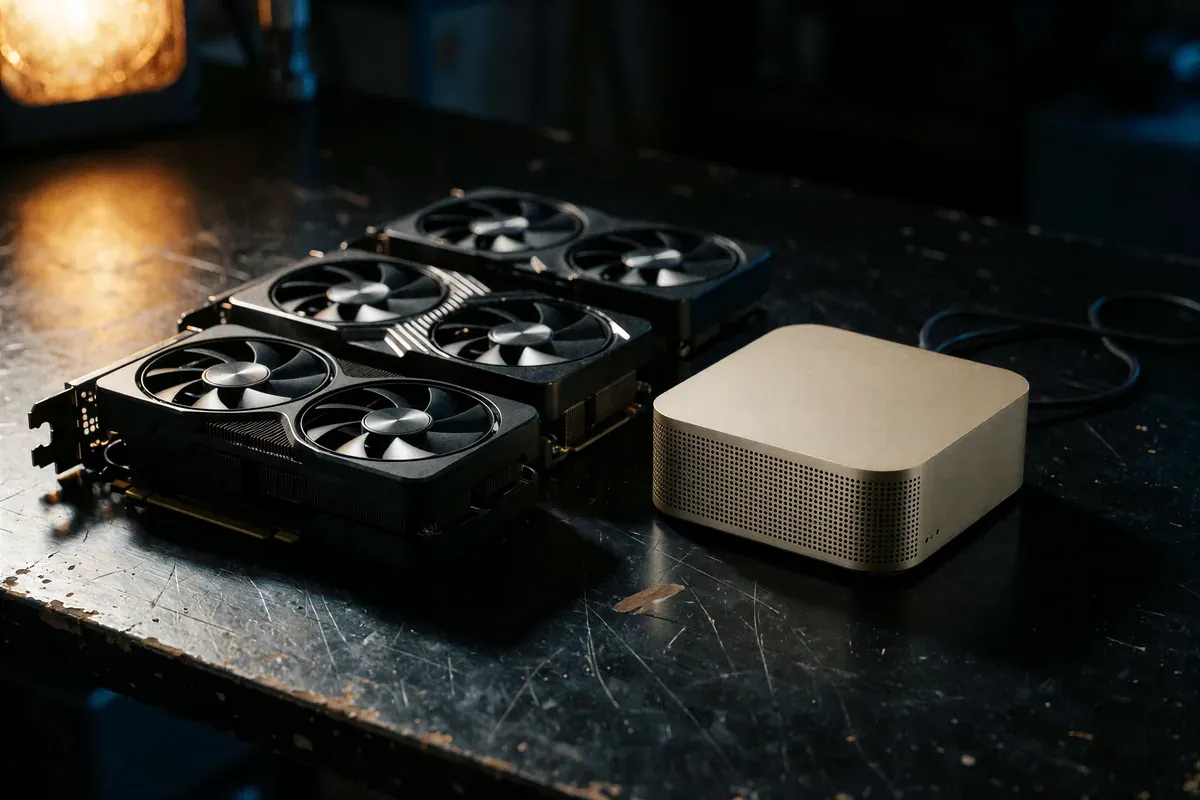
Speeds are gpt-oss-120b decode at batch 1 where a measurement exists.
Every GB10 box is the same chip: 128 GB at 273 GB/s, CUDA, and about 38 to 55 tok/s. Only the price changes.
- Dell Pro Max with GB10: $5,523 (1 TB) or $5,903 (2 TB).
- HP ZGX Nano G1n 2 TB: $5,999.
- Acer Veriton GN100: $5,999.
- NVIDIA DGX Spark Founders Edition: $6,950.
- MSI, ASUS, and Gigabyte GB10 boxes: $6,999 to $9,351.
The Strix Halo boxes are also 128 GB at about 273 GB/s, with no CUDA (ROCm and Vulkan instead) and about 47 tok/s in one test.
- GMKtec EVO-X2: $3,650.
- Framework Desktop: $3,449, out of stock.
- Beelink GTR9 Pro: $4,349, out of stock.
The rest differ on more than price.
- Mac Studio M5 Max 128 GB: $5,099 (512 GB) or $5,399 (1 TB). 614 GB/s, no CUDA (Metal and MLX), about 75 tok/s in one Ollama run.
- Mac Studio M5 Ultra 96 GB, 1 TB: $5,499. 1,200 GB/s, no CUDA, no measurement found.
- Four used RTX 3090s (cards only): about $4,000 to $5,800. 96 GB total, 936 GB/s per card, CUDA, no measurement found.
- RTX 5090 32 GB (card only): $4,300 to $5,030. About 1,792 GB/s, CUDA, but gpt-oss-120b does not fit.
On Strix Halo, Windows caps GPU memory at 96 GB; under Linux you can give the GPU about 120 GB. The 128 GB M5 Max needs the 40-core GPU, which starts at $3,099 with 48 GB, and 128 GB adds $2,000. The 3090 range is per-card eBay pricing ($1,000 to $1,450) times four, before a chassis, board, and power supply.
Where each alternative wins
Strix Halo (GMKtec, Framework, Beelink). Same bandwidth class and similar generation speed on gpt-oss-120b (about 47.5 tok/s versus about 45 on the Spark), at about 62 percent of Dell's price: roughly $27 to $34 per GB against $46 for the Dell 2 TB. Idle power is about 13 W against 35 to 45 W. You give up CUDA, about half the prompt-processing speed (about 1,000 tok/s versus about 1,800), and the 200 Gb fabric. For chat and agents on MoE models in ROCm or Vulkan land, Strix Halo is the better deal per dollar.
Mac Studio M5 Max 128 GB. About the same money as the Dell and 2.25 times the bandwidth. The one gpt-oss-120b measurement I found shows about 75 tok/s against about 50 on GB10, so for single-user generation at this price the Mac looks faster, with the caveat that it is one Ollama run against an SGLang one. No CUDA means no TensorRT or Triton; MLX and llama.cpp Metal are the tools.
Used RTX 3090s. Each card has 3.4 times the GB10's bandwidth and full CUDA. Four give 96 GB for roughly the Dell's price before the chassis, a board with enough slots, and a supply for 350 W per card. It is the fastest CUDA path per dollar if you have the space and noise tolerance.
RTX 5090. 32 GB is wonderful for anything that fits and irrelevant for gpt-oss-120b, which does not. At $4,300 to $5,030 for a card alone, the comparison with a complete 128 GB machine is uncomfortable.
Where the GB10 wins. CUDA with NVIDIA's own toolchain, FP4 tensor cores, prompt processing about twice Strix Halo's, 128 GB in a sub-200 W box that reviewers describe as quiet, and two 200 Gb ports so a second unit becomes a 256 GB pair without a switch.
Who should buy which
- Fine-tuning, CUDA or Triton kernel work, or mirroring a production NVIDIA stack at home, with 128 GB enough: the Dell GB10, or HP and Acer if Dell's page stays stuck.
- Fastest single-user chat on big MoE models for the same money, no CUDA needed: Mac Studio M5 Max 128 GB.
- Cheapest 128 GB and your stack already runs on ROCm or Vulkan: a Strix Halo box.
- You own a tower, want raw CUDA throughput, and do not mind the heat: used 3090s.
- More than 128 GB in one pool: read the next section, then look at the M5 Ultra.
Two boxes, one cable

The pairing is the part of the GB10 pitch no Mac or Strix Halo box can copy. Each unit has two 200 Gb QSFP ports on a ConnectX-7. NVIDIA's playbook has you connect one port on box A to one port on box B with a single cable, set static IPs, and use the same username and sudo on both; it budgets about an hour. Vendor pages describe a switchless ring for three boxes using both ports; I found no official material on switch-based stacks.
The cable is where buying Dell pays off. Dell's configurator adds a 50 cm QSFP cable for $50. The aftermarket Amphenol or Luxshare QSFP112 DAC runs $159 to $229, and NVIDIA's $99.99 marketplace cable is chronically out of stock. Compatibility is not automatic: the same Mellanox part number has been reported as both "does not work" and "passed nccl-test." One two-node test measured the link at 33 Gbps on a single iperf3 stream and 106 Gbps with four, well short of line rate without RDMA tuning.
What a pair does depends on software, and the published numbers split into two camps.
With vLLM tensor parallelism over RDMA, the pair speeds things up. A July 2026 vendor test ran Qwen3.6-27B in NVFP4 at concurrency 1 and got 12.63 tok/s on one box, 22.57 on two, and 33.11 on four, about 1.8 times for the pair on a model that already fits on one unit. The same tester ran DeepSeek V4 Flash 284B in official FP8 (155 GiB, too big for one box) with vLLM tensor parallel plus speculative decoding and measured 1,881 tok/s prompt processing and 75.6 tok/s generation at 2K context, holding 71.1 at 32K, 64.8 at 131K, and 69.0 at about 900K.
With llama.cpp over RPC, the pair is a capacity tool, not a speed tool. The same tester's earlier run found Qwen3-235B-A22B at 15.5 tok/s on one box and 14.6 on the pair, dense Devstral 2 123B at 2.64 either way, and prompt processing gains of roughly 14 to 25 percent. The pair did run models that do not fit on one unit: Llama 4 Maverick (143 GB) at 11 to 13 tok/s and Qwen3-Coder-480B (168 GB) at 9.86, while DeepSeek-V3 at 204 GB ran out of memory across both. On DeepSeek V4 Flash, the pair that did 75.6 tok/s under vLLM did 16.5 to 20 under RPC. In those tests, the practical ceiling with GGUF layer splitting was about 170 GB of weights.
NVIDIA says two linked Sparks handle models up to 405B parameters. That holds in the narrow sense that the weights fit at FP4 (about 200 GB); NVIDIA's vLLM playbook demonstrates this with a 64-token maximum length and one sequence. I found no measured throughput for a dense 405B on a pair. My own arithmetic estimate: 200 GB of weights at 273 GB/s is under 1.4 tok/s per box, and under about 3 tok/s with ideal tensor parallel across two. Treat 405B as a demonstration, not a workload.
Then the price. Two Dell 2 TB units plus one cable come to about $11,856; two 1 TB units about $11,100. Two HP ZGX Nanos plus an aftermarket cable land near $12,160. A Mac Studio M5 Ultra with 256 GB and 1 TB is $10,799: a single 256 GB pool at 1,200 GB/s, about 4.4 times a GB10's bandwidth with no inter-box link, for less than the Dell pair. The 512 GB M5 Ultra ships late October with no published price yet. A GB10 pair wins if you need CUDA, FP4 tensor prompt processing, or the option of running the two boxes independently. For plain generation on a huge MoE, the Mac should be the better buy at this price on bandwidth alone, though I found no measured M5 Ultra number.
Bottom line
At $5,523, the Dell Pro Max with GB10 is the cheapest 128 GB NVIDIA box I could find listed as of mid-October 2026. It is the pick if you need CUDA. If you do not, Strix Halo is cheaper and a Mac Studio M5 Max is faster at generation for the same money. Two Dells and a $50 cable are the cheapest route to 256 GB of CUDA memory, as long as you run models that gain from tensor parallel. Prices have moved fast this year, so check Dell's configurator before you buy.
Sources
- Dell, "Dell Pro Max with GB10 (FCM1253)" configurator, fetched 2026-10-12 and re-checked 2026-10-13, https://www.dell.com/en-us/shop/desktop-computers/spd/dellpromaxwithgb10fcm1253
- The Register, DGX Spark Founders Edition price rise to $6,950, 2026-10-02, https://www.theregister.com/a/5300622
- HotHardware, "NVIDIA DGX Spark 64GB release," 2026-10-02, https://hothardware.com/news/nvidia-dgx-spark-64gb-release
- NVIDIA, DGX Spark product page (64 GB "coming soon" via OEM partners), fetched 2026-10-12, https://www.nvidia.com/en-us/products/workstations/dgx-spark/
- NVIDIA Developer Forums, "September 2026 availability of GB10s" (store price reports), 2026-09-02, https://forums.developer.nvidia.com/t/september-2026-availability-of-gb10s/382068
- Newegg, GB10 search results, fetched 2026-10-12 (undated cache), https://www.newegg.com/p/pl?d=gb10
- LMSYS, "NVIDIA DGX Spark: great hardware, early days for the ecosystem," 2025-10-13, https://www.lmsys.org/blog/2025-10-13-nvidia-dgx-spark
- LMSYS, "gpt-oss on NVIDIA DGX Spark," 2025-11-03, https://lmsys.org/blog/2025-11-03-gpt-oss-on-nvidia-dgx-spark
- StorageReview, "Dell Pro Max with GB10 Review," https://www.storagereview.com/review/dell-pro-max-with-gb10-review
- HotHardware, "Dell Pro Max with GB10 Review," https://hothardware.com/reviews/dell-pro-max-with-gb10-review?page=1
- Phoronix, "Dell Pro Max GB10 llama.cpp" (power page), 2026-09-30, https://www.phoronix.com/review/dell-pro-max-gb10-llama-cpp/4
- ServeTheHome, "NVIDIA DGX Spark Review" (power and noise page), https://servethehome.com/nvidia-dgx-spark-review-the-gb10-machine-is-so-freaking-cool/4
- Tom's Hardware, "Nvidia DGX Spark update cuts idle power by 32 percent or more," https://tomshardware.com/tech-industry/artificial-intelligence/nvidia-dgx-spark-update-cuts-idle-power-by-32-percent-or-more-hot-plug-detection-on-connectx-nic-makes-for-a-more-efficient-ai-workstation
- Framework Community, "DGX Spark vs Strix Halo initial impressions," https://community.frame.work/t/dgx-spark-vs-strix-halo-initial-impressions/77055
- llmhardware.io, "Strix Halo mini PCs" price guide, as of 2026-10-11, https://www.llmhardware.io/guides/strix-halo-mini-pcs
- aiindigo, "Framework Desktop Ryzen AI Max+ 395 128GB" (Phoronix price, verified 2026-10-02), https://aiindigo.com/hardware/framework-desktop-ryzen-ai-max-395-128gb
- Apple, Mac Studio configurator (M5 Max, 18-core CPU, 40-core GPU), checked 2026-10-13, https://www.apple.com/shop/buy-mac/mac-studio
- Daring Fireball, "Update regarding the base prices of the M5 Max Mac Studio," 2026-08-25, https://daringfireball.net/linked/2026/08/25/update-regarding-the-base-prices-of-the-m5-max-mac-studio
- Macworld, "Apple announces the M5 Ultra Mac Studio with up to 512GB of RAM," 2026-08-25, https://macworld.com/article/3220024/apple-announces-the-m5-ultra-mac-studio-with-up-to-512gb-of-ram.html
- aicybr, "Mac Studio M5 Max / M5 Ultra 2026 price and specs," https://aicybr.com/blog/mac-studio-m5-max-m5-ultra-2026-price-specs-mac-mini-m6-comparison
- Guru3D, "GeForce RTX 5090 retail prices reach $4,300+," 2026-08-23, https://www.guru3d.com/story/geforce-rtx-5090-retail-prices-reach-as-standard-aircooled-cards-approach-halomodel-pricing/
- OpenClawDC, "Is a used RTX 3090 worth it for local LLM?" 2026-10-01, https://openclawdc.com/blog/is-a-used-rtx-3090-worth-it-local-llm/
- NVIDIA, "Connect two Sparks" playbook, updated 2026-07-21, https://build.nvidia.com/spark/connect-two-sparks
- NVIDIA, vLLM "stacked Sparks" playbook (read via search summary), https://build.nvidia.com/spark/vllm/stacked-sparks
- NVIDIA Developer Forums, "Suggested cable to link two Sparks," https://forums.developer.nvidia.com/t/suggested-cable-to-link-two-sparks/348207
- Petronella Technology Group, "What cable do I need to connect two DGX Sparks?" https://petronellatech.com/blog/what-cable-do-i-need-to-connect-two-dgx-sparks/
- Classmethod, "DGX Spark two-node clustering," https://dev.classmethod.jp/en/articles/dgx-spark-two-node-clustering/
- Classmethod, "DeepSeek V4 Flash on two DGX Sparks," measured 2026-08-10, https://dev.classmethod.jp/en/articles/dgx-spark-2node-deepseek-v4-flash-0731/
- Openzeka, "Qwen3.6-27B DGX Spark scaling" whitepaper, July 2026, https://whitepapers.openzeka.com/papers/qwen3.6-27b-dgx-spark-scaling/
Comments
// Comments are reviewed before appearing. No spam. No noise.